 |
PDBsum entry 6pg2

|
|
|
|
|
|

|

|

|

|
|

|
|

|
|

|
|

|
|

|
|

|
|

|
|
|
 |

|

|
|
|
|
|
|
|
|
|
|
|
|
|
|
|
|
|
|
|
|
|
|
|
|
|
|
|
|
|
|
|
|
|
|
|
|
Oxidoreductase/inhibitor
|
PDB id
|
|
|
|
6pg2
|
|
|
|
|
|
|
|
|
|
|
|
|
|
|

|

|

|
|
|
|
|
|
|
PDB id:
|
|
|
|
| Name: |
|
Oxidoreductase/inhibitor
|
|
|
Title:
|
|
Crystal structure of ecdsba in a complex with unpurified reaction product h5 (morpholine 8)
|
|
Structure:
|
|
Thiol:disulfide interchange protein dsba. Chain: a, b. Engineered: yes
|
|
Source:
|
|
Escherichia coli (strain k12). Organism_taxid: 83333. Strain: k12. Gene: dsba, dsf, ppfa, b3860, jw3832. Expressed in: escherichia coli bl21(de3). Expression_system_taxid: 469008.
|
|
Resolution:
|
|
|
1.91Å
|
R-factor:
|
0.186
|
R-free:
|
0.223
|
|
|
Authors:
|
|
O.V.Ilyichova,M.Bentley,B.Doak,M.J.Scanlon
|
|
Key ref:
|
|
M.R.Bentley
et al.
(2020).
Rapid Elaboration of Fragments into Leads by X-ray Crystallographic Screening of Parallel Chemical Libraries (REFiLX).
J Med Chem,
63,
6863-6875.
PubMed id:
DOI:
|
|
|
Date:
|
|
|
23-Jun-19
|
Release date:
|
06-May-20
|
|
|
|
|
|
|
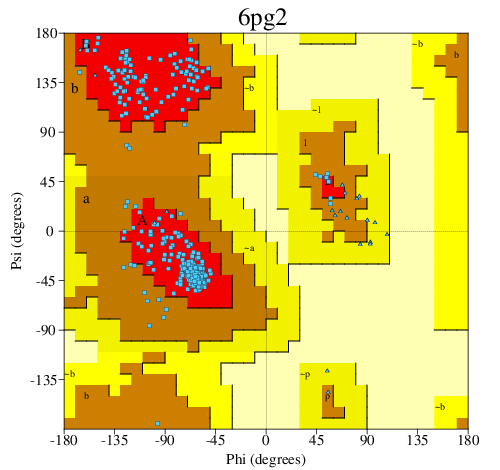
PROCHECK
|
|
|
|
|
|
Headers
|
|
|
|
References
|
|
|
|
|
|

|
|
P0AEG4
(DSBA_ECOLI) -
Thiol:disulfide interchange protein DsbA from Escherichia coli (strain K12)
|
|
|
|
Seq:
Struc:
|
|
|
|
208 a.a.
188 a.a.
|
|

|

|
|
|
|
|
|
|
|
|
|
|
|
Key: |
 |
PfamA domain |
|
|
 |
Secondary structure |
|
|
|
|
|
|
|
|
|
|
|
|
|
|
|
|
|
 |
|
|
|
|
|
|
| |
|
DOI no:
|
J Med Chem
63:6863-6875
(2020)
|
|
PubMed id:
|
|
|
|
|
|
| |
|
Rapid Elaboration of Fragments into Leads by X-ray Crystallographic Screening of Parallel Chemical Libraries (REFiLX).
|
|
M.R.Bentley,
O.V.Ilyichova,
G.Wang,
M.L.Williams,
G.Sharma,
W.S.Alwan,
R.L.Whitehouse,
B.Mohanty,
P.J.Scammells,
B.Heras,
J.L.Martin,
M.Totsika,
B.Capuano,
B.C.Doak,
M.J.Scanlon.
|
|
|
|
|
| |
ABSTRACT
|
|
|
|
| |
|
|
A bottleneck in fragment-based lead development is the lack of systematic
approaches to elaborate the initial fragment hits, which usually bind with low
affinity to their target. Herein, we describe an analysis using X-ray
crystallography of a diverse library of compounds prepared using microscale
parallel synthesis. This approach yielded an 8-fold increase in affinity and
detailed structural information for the resulting complex, providing an
efficient and broadly applicable approach to early fragment development.
|
|
|
|
|
|
|
|
|
|
|
|
|
|
|
|
|
|
 |
 |
 |
|


 Links
Links


