 |
PDBsum entry 6ok4

|
|
|
|
|
|

|

|

|

|
|

|
|

|
|

|
|

|
|

|
|

|
|

|
|
|
 |

|

|
|
|
|
|
|
|
|
|
|
|
|
|
|
|
|
|
|
|
|
|
|
|
|
|
|
|
|
|
|
|
|
|
|
|
|
Oxidoreductase
|
PDB id
|
|
|
|
6ok4
|
|
|
|
|
|
|
|
|
|
|
|
|
|
|

|

|

|
|
|
|
|
|
|
|
|
Enzyme class:
|
|
E.C.1.2.1.12
- glyceraldehyde-3-phosphate dehydrogenase (phosphorylating).
|
|
|
|
|
|
|
Pathway:
|
|
Glyceraldehyde-3-phosphate Dehydrogenase (phosphorylating)
|
|
|
|
|
|
Reaction:
|
|
D-glyceraldehyde 3-phosphate + phosphate + NAD+ = (2R)-3-phospho- glyceroyl phosphate + NADH + H+
|
|
|
|
|
|
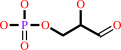 D-glyceraldehyde 3-phosphate
|
+
|
phosphate
Bound ligand (Het Group name = )
corresponds exactly
|
+
|
NAD(+)
Bound ligand (Het Group name = )
corresponds exactly
|
=
|
(2R)-3-phospho- glyceroyl phosphate
|
+
|
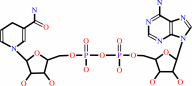 NADH
NADH
|
+
|
H(+)
|
|
|
|
|
|
|
|
|
|
|
|
|
Molecule diagrams generated from .mol files obtained from the
KEGG ftp site
|
|
|
|
|
|
|
|
|
|
|
|
|
|
 |
|
|
|
|
|
|
| |
|
|
| |
|
DOI no:
|
Protein Sci
29:768-778
(2020)
|
|
PubMed id:
|
|
|
|
|
|
| |
|
Structures of glyceraldehyde 3-phosphate dehydrogenase in Neisseria gonorrhoeae and Chlamydia trachomatis.
|
|
K.F.Barrett,
D.M.Dranow,
I.Q.Phan,
S.A.Michaels,
S.Shaheen,
E.D.Navaluna,
J.K.Craig,
L.M.Tillery,
R.Choi,
T.E.Edwards,
D.G.Conrady,
J.Abendroth,
P.S.Horanyi,
D.D.Lorimer,
W.C.Van Voorhis,
Z.Zhang,
L.K.Barrett,
S.Subramanian,
B.Staker,
E.Fan,
P.J.Myler,
O.O.Soge,
K.Hybiske,
K.K.Ojo.
|
|
|
|
|
| |
ABSTRACT
|
|
|
|
| |
|
|
Neisseria gonorrhoeae (Ng) and Chlamydia trachomatis (Ct) are the most commonly
reported sexually transmitted bacteria worldwide and usually present as
co-infections. Increasing resistance of Ng to currently recommended dual therapy
of azithromycin and ceftriaxone presents therapeutic challenges for syndromic
management of Ng-Ct co-infections. Development of a safe, effective, and
inexpensive dual therapy for Ng-Ct co-infections is an effective strategy for
the global control and prevention of these two most prevalent bacterial sexually
transmitted infections. Glyceraldehyde-3-phosphate dehydrogenase (GAPDH) is a
validated drug target with two approved drugs for indications other than
antibacterials. Nonetheless, any new drugs targeting GAPDH in Ng and Ct must be
specific inhibitors of bacterial GAPDH that do not inhibit human GAPDH, and
structural information of Ng and Ct GAPDH will aid in finding such selective
inhibitors. Here, we report the X-ray crystal structures of Ng and Ct GAPDH.
Analysis of the structures demonstrates significant differences in amino acid
residues in the active sites of human GAPDH from those of the two bacterial
enzymes suggesting design of compounds to selectively inhibit Ng and Ct is
possible. We also describe an efficient in vitro assay of recombinant GAPDH
enzyme activity amenable to high-throughput drug screening to aid in identifying
inhibitory compounds and begin to address selectivity.
|
|
|
|
|
|
|
|
|
|
|
|
|
|
|
|
|
|
 |
 |
 |
|


 Links
Links


