 |
PDBsum entry 6mst

|
|
|
|
|
|

|

|

|

|
|

|
|

|
|

|
|

|
|
|
 |

|

|
|
|
|
|
|
|
|
|
|
|
|
|
|
|
|
|
|
|
|
|
|
|
|
|
|
|
|
|
|
|
|
|
Protein fibril
|
PDB id
|
|
|
|
6mst
|
|
|
|
|
|
|
|
|
|
|
|
|
|
|

|

|

|
|
|
|
|
|
|
PDB id:
|
|
|
|
| Name: |
|
Protein fibril
|
|
|
Title:
|
|
Cryo-em structure of human aa amyloid fibril
|
|
Structure:
|
|
Serum amyloid a-1 protein. Chain: a, b, c, e, d, f, h, i, j, k, l, g. Synonym: saa
|
|
Source:
|
|
Homo sapiens. Human. Organism_taxid: 9606
|
|
Authors:
|
|
S.Loerch,M.Rennegarbe,F.Liberta,N.Grigorieff,M.Fandrich,M.Schmidt
|
|
Key ref:
|
|
F.Liberta
et al.
(2019).
Cryo-EM fibril structures from systemic AA amyloidosis reveal the species complementarity of pathological amyloids.
Nat Commun,
10,
1104.
PubMed id:
DOI:
|
|
|
Date:
|
|
|
18-Oct-18
|
Release date:
|
13-Mar-19
|
|
|
|
|
|
|
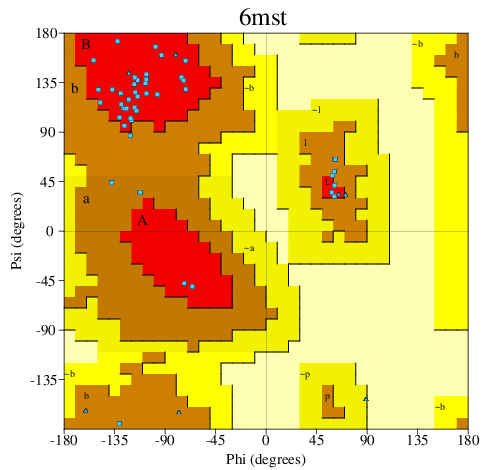
PROCHECK
|
|
|
|
|
|
Headers
|
|
|
|
References
|
|
|
|
|
|

|
|
P0DJI8
(SAA1_HUMAN) -
Serum amyloid A-1 protein from Homo sapiens
|
|
|
|
Seq:
Struc:
|
|
|
|
122 a.a.
54 a.a.*
|
|

|

|
|
|
|
|
|
|
|
|
|
|
|
Key: |
|
 |
Secondary structure |
|
|
*
PDB and UniProt seqs differ
at 1 residue position (black
cross)
|
|
|
|
|
|
|
|
|
|
|
|
|
|
|
|
|
 |
|
|
|
|
|
|
| |
|
DOI no:
|
Nat Commun
10:1104
(2019)
|
|
PubMed id:
|
|
|
|
|
|
| |
|
Cryo-EM fibril structures from systemic AA amyloidosis reveal the species complementarity of pathological amyloids.
|
|
F.Liberta,
S.Loerch,
M.Rennegarbe,
A.Schierhorn,
P.Westermark,
G.T.Westermark,
B.P.C.Hazenberg,
N.Grigorieff,
M.Fändrich,
M.Schmidt.
|
|
|
|
|
| |
ABSTRACT
|
|
|
|
| |
|
|
Systemic AA amyloidosis is a worldwide occurring protein misfolding disease of
humans and animals. It arises from the formation of amyloid fibrils from the
acute phase protein serum amyloid A. Here, we report the purification and
electron cryo-microscopy analysis of amyloid fibrils from a mouse and a human
patient with systemic AA amyloidosis. The obtained resolutions are 3.0 Å and
2.7 Å for the murine and human fibril, respectively. The two fibrils differ
in fundamental properties, such as presence of right-hand or left-hand twisted
cross-β sheets and overall fold of the fibril proteins. Yet, both proteins
adopt highly similar β-arch conformations within the N-terminal ~21 residues.
Our data demonstrate the importance of the fibril protein N-terminus for the
stability of the analyzed amyloid fibril morphologies and suggest strategies of
combating this disease by interfering with specific fibril polymorphs.
|
|
|
|
|
|
|
|
|
|
|
|
|
|
|
|
|
|
 |
 |
 |
|


 Links
Links


