 |
PDBsum entry 6mnc

|
|
|
|
|
|

|

|

|

|
|

|
|

|
|

|
|

|
|

|
|

|
|
|
 |

|

|
|
|
|
|
|
|
|
|
|
|
|
|
|
|
|
|
|
|
|
|
|
|
|
|
|
|
|
|
|
|
|
|
|
|
Oxidoreductase
|
PDB id
|
|
|
|
6mnc
|
|
|
|
|
|
|
|
|
|
|
|
|
|
|

|

|

|
|
|
|
|
|
|
PDB id:
|
|
|
|
| Name: |
|
Oxidoreductase
|
|
|
Title:
|
|
Crystal structure of human 17beta-hydroxysteroid dehydrogenase type 1 complexed with estrone
|
|
Structure:
|
|
Estradiol 17-beta-dehydrogenase 1. Chain: a, b. Synonym: 17-beta-hydroxysteroid dehydrogenase type 1,17-beta-hsd 1,20 alpha-hydroxysteroid dehydrogenase,20-alpha-hsd,e2dh,placental 17- beta-hydroxysteroid dehydrogenase,short chain dehydrogenase/reductase family 28c member 1. Engineered: yes
|
|
Source:
|
|
Homo sapiens. Human. Organism_taxid: 9606. Gene: hsd17b1, e17ksr, edh17b1, edh17b2, edhb17, sdr28c1. Expressed in: spodoptera frugiperda. Expression_system_taxid: 7108.
|
|
Resolution:
|
|
|
2.40Å
|
R-factor:
|
0.211
|
R-free:
|
0.287
|
|
|
Authors:
|
|
T.Li,P.Stephen,D.W.Zhu,S.X.Lin
|
|
Key ref:
|
|
T.Li
et al.
(2019).
Crystal structures of human 17β-hydroxysteroid dehydrogenase type 1 complexed with estrone and NADP+ reveal the mechanism of substrate inhibition.
FEBS J,
286,
2155-2166.
PubMed id:
DOI:
|
|
|
Date:
|
|
|
01-Oct-18
|
Release date:
|
03-Apr-19
|
|
|
|
|
|
|
PROCHECK
|

|
|
|
|
|
Headers
|
|
|
|
References
|
|
|
|
|
|

|
|
P14061
(DHB1_HUMAN) -
17-beta-hydroxysteroid dehydrogenase type 1 from Homo sapiens
|
|
|
|
Seq:
Struc:
|
|
|
|
328 a.a.
276 a.a.
|
|

|

|

|
|
|
|
|
|
|
|
|
|
|
Key: |
 |
PfamA domain |
|
|
 |
Secondary structure |
|
|
|
|
|
|
|
|
|
|
|
|
|
Enzyme class 1:
|
|
E.C.1.1.1.51
- 3(or 17)beta-hydroxysteroid dehydrogenase.
|
|
|
|
|
|
|
Reaction:
|
|
|
1.
|
testosterone + NAD+ = androst-4-ene-3,17-dione + NADH + H+
|
|
2.
|
testosterone + NADP+ = androst-4-ene-3,17-dione + NADPH + H+
|
|
|
|
|
|
|
 testosterone
|
+
|
NAD(+)
Bound ligand (Het Group name = )
matches with 95.24% similarity
|
=
|
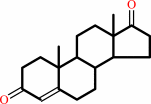 androst-4-ene-3,17-dione
|
+
|
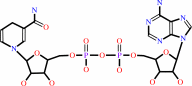 NADH
NADH
|
+
|
H(+)
|
|
|
|
|
|
|
testosterone
|
+
|
NADP(+)
Bound ligand (Het Group name = )
matches with 95.24% similarity
|
=
|
androst-4-ene-3,17-dione
|
+
|
 NADPH
NADPH
|
+
|
H(+)
|
|
|
|
|
|
|
|
|
|
Enzyme class 2:
|
|
E.C.1.1.1.62
- 17beta-estradiol 17-dehydrogenase.
|
|
|
|
|
|
|
Reaction:
|
|
|
1.
|
17beta-estradiol + NAD+ = estrone + NADH + H+
|
|
2.
|
17beta-estradiol + NADP+ = estrone + NADPH + H+
|
|
|
|
|
|
|
17beta-estradiol
|
+
|
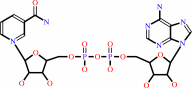 NAD(+)
|
=
|
estrone
Bound ligand (Het Group name = )
corresponds exactly
|
+
|
NADH
|
+
|
H(+)
|
|
|
|
|
|
|
17beta-estradiol
|
+
|
 NADP(+)
|
=
|
estrone
Bound ligand (Het Group name = )
corresponds exactly
|
+
|
NADPH
|
+
|
H(+)
|
|
|
|
|
|
|
|
|
|
|
|
|
Note, where more than one E.C. class is given (as above), each may
correspond to a different protein domain or, in the case of polyprotein
precursors, to a different mature protein.
|
|
|
|
Molecule diagrams generated from .mol files obtained from the
KEGG ftp site
|
|
|
|
|
|
|
|
|
|
|
|
|
|
 |
|
|
|
|
|
|
| |
|
|
| |
|
DOI no:
|
FEBS J
286:2155-2166
(2019)
|
|
PubMed id:
|
|
|
|
|
|
| |
|
Crystal structures of human 17β-hydroxysteroid dehydrogenase type 1 complexed with estrone and NADP+ reveal the mechanism of substrate inhibition.
|
|
T.Li,
P.Stephen,
D.W.Zhu,
R.Shi,
S.X.Lin.
|
|
|
|
|
| |
ABSTRACT
|
|
|
|
| |
|
|
Human 17β-hydroxysteroid dehydrogenase type 1 (17β-HSD1) catalyses the last
step in estrogen activation and is thus involved in estrogen-dependent diseases
(EDDs). Unlike other 17β-HSD members, 17β-HSD1 undergoes a significant
substrate-induced inhibition that we have previously reported. Here we solved
the binary and ternary crystal structures of 17β-HSD1 in complex with estrone
(E1) and cofactor analog NADP+ , demonstrating critical
enzyme-substrate-cofactor interactions. These complexes revealed a reversely
bound E1 in 17β-HSD1 that provides the basis of the substrate inhibition, never
demonstrated in estradiol complexes. Structural analysis showed that
His221 is the key residue responsible for the reorganization and
stabilization of the reversely bound E1, leading to the formation of a dead-end
complex, which exists widely in NADP(H)-preferred enzymes for the regulation of
their enzymatic activity. Further, a new inhibitor is proposed that may inhibit
17β-HSD1 through the formation of a dead-end complex. This finding indicates a
simple mechanism of enzyme regulation in the physiological background and
introduces a pioneer inhibitor of 17β-HSD1 based on the dead-end inhibition
model for efficiently targeting EDDs. DATABASES: Coordinates and structure
factors of 17β-HSD1-E1 and 17β-HSD1-E1-NADP+ have been deposited in
the Protein Data Bank with accession code 6MNC and 6MNE respectively. ENZYMES:
17β-hydroxysteroid dehydrogenase type 1 (17β-HSD1) EC 1.1.1.62.
|
|
|
|
|
|
|
|
|
|
|
|
|
|
|
|
|
|
 |
 |
 |
|


 Links
Links


