 |
PDBsum entry 6ljs

|
|
|
|
|
|

|

|

|

|
|

|
|

|
|

|
|

|
|
|
 |

|

|
|
|
|
|
|
|
|
|
|
|
|
|
|
|
|
|
|
|
|
|
|
|
|
|
|
|
|
|
|
|
|
|
Lipid binding protein
|
PDB id
|
|
|
|
6ljs
|
|
|
|
|
|
|
|
|
|
|
|
|
|
|

|

|

|
|
|
|
|
|
|
PDB id:
|
|
|
|
| Name: |
|
Lipid binding protein
|
|
|
Title:
|
|
Crystal structure of human fabp4 in complex with a novel inhibitor
|
|
Structure:
|
|
Fatty acid-binding protein, adipocyte. Chain: a. Synonym: adipocyte lipid-binding protein,albp,adipocyte-type fatty acid-binding protein,afabp,fatty acid-binding protein 4. Engineered: yes
|
|
Source:
|
|
Homo sapiens. Human. Organism_taxid: 9606. Gene: fabp4. Expressed in: escherichia coli bl21(de3). Expression_system_taxid: 469008.
|
|
Resolution:
|
|
|
1.75Å
|
R-factor:
|
0.185
|
R-free:
|
0.224
|
|
|
Authors:
|
|
H.X.Su,X.L.Zhang,M.J.Li,Y.C.Xu
|
|
Key ref:
|
|
H.Su
et al.
(2020).
Exploration of Fragment Binding Poses Leading to Efficient Discovery of Highly Potent and Orally Effective Inhibitors of FABP4 for Anti-inflammation.
J Med Chem,
63,
4090-4106.
PubMed id:
DOI:
|
|
|
Date:
|
|
|
17-Dec-19
|
Release date:
|
15-Apr-20
|
|
|
|
|
|
|
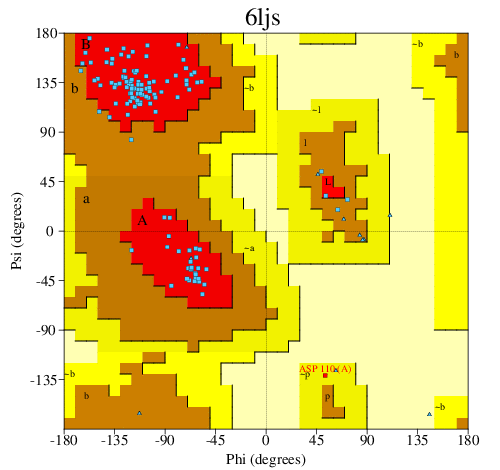
PROCHECK
|
|
|
|
|
|
Headers
|
|
|
|
References
|
|
|
|
|
|

|
|
P15090
(FABP4_HUMAN) -
Fatty acid-binding protein, adipocyte from Homo sapiens
|
|
|
|
Seq:
Struc:
|
|
|
|
132 a.a.
136 a.a.
|
|

|

|
|
|
|
|
|
|
|
|
|
|
|
Key: |
 |
PfamA domain |
|
|
 |
Secondary structure |
|
|
|
|
|
|
|
|
|
|
|
|
|
|
|
|
|
 |
|
|
|
|
|
|
| |
|
DOI no:
|
J Med Chem
63:4090-4106
(2020)
|
|
PubMed id:
|
|
|
|
|
|
| |
|
Exploration of Fragment Binding Poses Leading to Efficient Discovery of Highly Potent and Orally Effective Inhibitors of FABP4 for Anti-inflammation.
|
|
H.Su,
Y.Zou,
G.Chen,
H.Dou,
H.Xie,
X.Yuan,
X.Zhang,
N.Zhang,
M.Li,
Y.Xu.
|
|
|
|
|
| |
ABSTRACT
|
|
|
|
| |
|
|
Fatty-acid binding protein 4 (FABP4) is a promising therapeutic target for
immunometabolic diseases, while its potential for systemic inflammatory response
syndrome treatment has not been explored. Here, a series of
2-(phenylamino)benzoic acids as novel and potent FABP4 inhibitors are rationally
designed based on an interesting fragment that adopts multiple binding poses
within FABP4. A fusion of these binding poses leads to the design of compound
3 with an ∼460-fold improvement in binding affinity compared to the
initial fragment. A subsequent structure-aided optimization upon 3
results in a promising lead (17) with the highest binding affinity among
all the inhibitors, exerting a significant anti-inflammatory effect in cells and
effectively attenuating a systemic inflammatory damage in mice. Our work
therefore presents a good example of lead compound discovery derived from the
multiple binding poses of a fragment and provides a candidate for development of
drugs against inflammation-related diseases.
|
|
|
|
|
|
|
|
|
|
|
|
|
|
|
|
|
|
 |
 |
 |
|


 Links
Links


