 |
PDBsum entry 6guh
|
|

|
|
PDB id:
|
|
|
|
| Name: |
|
Cell cycle
|
|
|
Title:
|
|
Cdk2 in complex with azd5438
|
|
Structure:
|
|
Cyclin-dependent kinase 2. Chain: a. Synonym: cell division protein kinase 2,p33 protein kinase. Engineered: yes
|
|
Source:
|
|
Homo sapiens. Human. Organism_taxid: 9606. Gene: cdk2, cdkn2. Expressed in: escherichia coli bl21(de3). Expression_system_taxid: 469008.
|
|
Resolution:
|
|
|
1.50Å
|
R-factor:
|
0.201
|
R-free:
|
0.243
|
|
|
Authors:
|
|
D.J.Wood,S.Korolchuk,N.J.Tatum,L.Z.Wang,J.A.Endicott,M.E.M.Noble, M.P.Martin
|
|
Key ref:
|
|
D.J.Wood
et al.
(2019).
Differences in the Conformational Energy Landscape of CDK1 and CDK2 Suggest a Mechanism for Achieving Selective CDK Inhibition.
Cell Chem Biol,
26,
121.
PubMed id:
DOI:
|
|
|
Date:
|
|
|
19-Jun-18
|
Release date:
|
05-Dec-18
|
|
|
|
|
|
|
PROCHECK
|

|
|
|
|
|
Headers
|
|
|
|
References
|
|
|
|
|
|

|
|
P24941
(CDK2_HUMAN) -
Cyclin-dependent kinase 2 from Homo sapiens
|
|
|
|
Seq:
Struc:
|
|
|
|
298 a.a.
284 a.a.
|
|

|

|

|
|
|
|
|
|
|
|
|
|
|
Key: |
 |
PfamA domain |
|
|
 |
Secondary structure |
|
|
|
|
|
|
|
|
|
|
|
|
|
Enzyme class:
|
|
E.C.2.7.11.22
- cyclin-dependent kinase.
|
|
|
|
|
|
|
Reaction:
|
|
|
1.
|
L-seryl-[protein] + ATP = O-phospho-L-seryl-[protein] + ADP + H+
|
|
2.
|
L-threonyl-[protein] + ATP = O-phospho-L-threonyl-[protein] + ADP + H+
|
|
|
|
|
|
|
L-seryl-[protein]
|
+
|
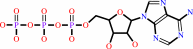 ATP
ATP
|
=
|
O-phospho-L-seryl-[protein]
|
+
|
 ADP
ADP
|
+
|
H(+)
|
|
|
|
|
|
|
L-threonyl-[protein]
|
+
|
ATP
|
=
|
O-phospho-L-threonyl-[protein]
|
+
|
ADP
|
+
|
H(+)
|
|
|
|
|
|
|
|
|
|
|
|
|
Molecule diagrams generated from .mol files obtained from the
KEGG ftp site
|
|
|
|
|
|
|
|
|
|
|
|
|
|
 |
|
|
|
|
|
|
| |
|
|
| |
|
DOI no:
|
Cell Chem Biol
26:121
(2019)
|
|
PubMed id:
|
|
|
|
|
|
| |
|
Differences in the Conformational Energy Landscape of CDK1 and CDK2 Suggest a Mechanism for Achieving Selective CDK Inhibition.
|
|
D.J.Wood,
S.Korolchuk,
N.J.Tatum,
L.Z.Wang,
J.A.Endicott,
M.E.M.Noble,
M.P.Martin.
|
|
|
|
|
| |
ABSTRACT
|
|
|
|
| |
|
|
Dysregulation of the cell cycle characterizes many cancer subtypes, providing a
rationale for developing cyclin-dependent kinase (CDK) inhibitors. Potent CDK2
inhibitors might target certain cancers in which CCNE1 is amplified. However,
current CDK2 inhibitors also inhibit CDK1, generating a toxicity liability. We
have used biophysical measurements and X-ray crystallography to investigate the
ATP-competitive inhibitor binding properties of cyclin-free and cyclin-bound
CDK1 and CDK2. We show that these kinases can readily be distinguished by such
inhibitors when cyclin-free, but not when cyclin-bound. The basis for this
discrimination is unclear from either inspection or molecular dynamics
simulation of ligand-bound CDKs, but is reflected in the contacts made between
the kinase N- and C-lobes. We conclude that there is a subtle but profound
difference between the conformational energy landscapes of cyclin-free CDK1 and
CDK2. The unusual properties of CDK1 might be exploited to differentiate CDK1
from other CDKs in future cancer therapeutic design.
|
|
|
|
|
|
|
|
|
|
|
|
|
|
|
|
|
|
 |
 |
 |
|


 Links
Links


