 |
PDBsum entry 6f8s
|
|

|
|
PDB id:
|
|
|
|
| Name: |
|
Toxin
|
|
|
Title:
|
|
Toxin-antitoxin complex grata
|
|
Structure:
|
|
Xre family transcriptional regulator. Chain: a, c. Engineered: yes. Other_details: antitoxin graa. Putative killer protein. Chain: b, d. Engineered: yes. Other_details: toxin grat
|
|
Source:
|
|
Pseudomonas putida. Arthrobacter siderocapsulatus. Organism_taxid: 303. Gene: ayo08_18510. Expressed in: escherichia coli bl21(de3). Expression_system_taxid: 469008. Pseudomonas putida (strain atcc 47054 / dsm 6125 / ncimb 11950 / kt2440). Organism_taxid: 160488.
|
|
Resolution:
|
|
|
2.50Å
|
R-factor:
|
0.180
|
R-free:
|
0.212
|
|
|
Authors:
|
|
A.Talavera,R.Loris
|
|
Key ref:
|
|
A.Talavera
et al.
(2019).
A dual role in regulation and toxicity for the disordered N-terminus of the toxin GraT.
Nat Commun,
10,
972.
PubMed id:
DOI:
|
|
|
Date:
|
|
|
13-Dec-17
|
Release date:
|
11-Jul-18
|
|
|
|
|
|
|
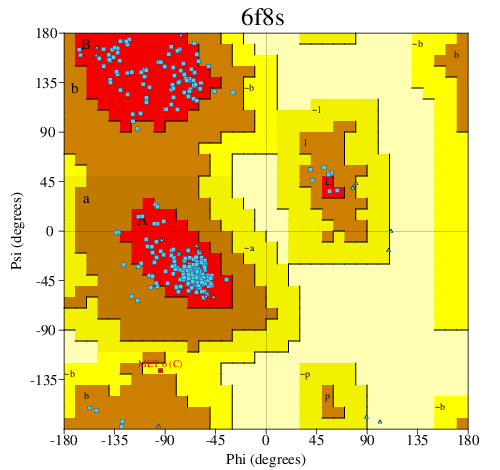
PROCHECK
|
|
|
|
|
|
Headers
|
|
|
|
References
|
|
|
|
|
|

|
|
Q88MI6
(Q88MI6_PSEPK) -
Antidote protein from Pseudomonas putida (strain ATCC 47054 / DSM 6125 / CFBP 8728 / NCIMB 11950 / KT2440)
|
|
|
|
Seq:
Struc:
|
|
|
|
99 a.a.
94 a.a.
|
|

|

|
|
|
|
|
|
|
|
|
|
|
|
|
|
|
|
|
|
Enzyme class:
|
|
Chains A, B, C, D:
E.C.?
|
|
|
|
|
|
|
|
|
|
|
|
|
|
|
|
|
|
|
 |
|
|
|
|
|
|
| |
|
DOI no:
|
Nat Commun
10:972
(2019)
|
|
PubMed id:
|
|
|
|
|
|
| |
|
A dual role in regulation and toxicity for the disordered N-terminus of the toxin GraT.
|
|
A.Talavera,
H.Tamman,
A.Ainelo,
A.Konijnenberg,
S.Hadži,
F.Sobott,
A.Garcia-Pino,
R.Hõrak,
R.Loris.
|
|
|
|
|
| |
ABSTRACT
|
|
|
|
| |
|
|
Bacterial toxin-antitoxin (TA) modules are tightly regulated to maintain growth
in favorable conditions or growth arrest during stress. A typical regulatory
strategy involves the antitoxin binding and repressing its own promoter while
the toxin often acts as a co-repressor. Here we show that Pseudomonas putida
graTA-encoded antitoxin GraA and toxin GraT differ from other TA proteins in the
sense that not the antitoxin but the toxin possesses a flexible region. GraA
auto-represses the graTA promoter: two GraA dimers bind cooperatively at
opposite sides of the operator sequence. Contrary to other TA modules, GraT is a
de-repressor of the graTA promoter as its N-terminal disordered segment prevents
the binding of the GraT2A2 complex to the operator.
Removal of this region restores operator binding and abrogates Gr aT toxicity.
GraTA represents a TA module where a flexible region in the toxin rather than in
the antitoxin controls operon expression and toxin activity.
|
|
|
|
|
|
|
|
|
|
|
|
|
|
|
|
|
|
 |
 |
 |
|
| |


 Links
Links


