 |
PDBsum entry 6epm

|
|
|
|
|
|

|

|

|

|
|

|
|

|
|

|
|

|
|

|
|

|
|
|
 |

|

|
|
|
|
|
|
|
|
|
|
|
|
|
|
|
|
|
|
|
|
|
|
|
|
|
|
|
|
|
|
|
|
|
|
|
Signaling protein
|
PDB id
|
|
|
|
6epm
|
|
|
|
|
|
|
|
|
|
|
|
|
|
|

|

|

|
|
|
|
|
|
|
PDB id:
|
|
|
|
| Name: |
|
Signaling protein
|
|
|
Title:
|
|
Ras guanine nucleotide exchange factor sos1 (rem-cdc25) in complex with kras(g12c) and fragment screening hit f1
|
|
Structure:
|
|
Gtpase kras. Chain: r. Synonym: k-ras 2,ki-ras,c-k-ras,c-ki-ras. Engineered: yes. Mutation: yes. Other_details: n-terminal gly (position -1 compared to uniprot entry) is a cloning artifact. Son of sevenless homolog 1. Chain: s.
|
|
Source:
|
|
Homo sapiens. Human. Organism_taxid: 9606. Gene: kras, kras2, rask2. Expressed in: escherichia coli. Expression_system_taxid: 562. Gene: sos1. Expression_system_taxid: 562
|
|
Resolution:
|
|
|
2.50Å
|
R-factor:
|
0.181
|
R-free:
|
0.211
|
|
|
Authors:
|
|
R.C.Hillig,D.Moosmayer,A.Hilpmann,B.Bader,J.Schroeder,L.Wortmann, B.Sautier,J.Kahmann,D.Wegener,H.Briem,K.Petersen,V.Badock
|
|
Key ref:
|
|
R.C.Hillig
et al.
(2019).
Discovery of potent SOS1 inhibitors that block RAS activation via disruption of the RAS-SOS1 interaction.
Proc Natl Acad Sci U S A,
116,
2551-2560.
PubMed id:
DOI:
|
|
|
Date:
|
|
|
12-Oct-17
|
Release date:
|
06-Feb-19
|
|
|
|
|
|
|
PROCHECK
|

|
|
|
|
|
Headers
|
|
|
|
References
|
|
|
|
|
|
|
|
|
|
|
|
Enzyme class:
|
|
Chain R:
E.C.3.6.5.2
- small monomeric GTPase.
|
|
|
|
|
|
|
Reaction:
|
|
GTP + H2O = GDP + phosphate + H+
|
|
|
|
|
|
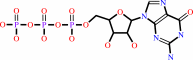 GTP
GTP
|
+
|
H2O
|
=
|
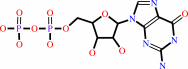 GDP
GDP
|
+
|
 phosphate
|
+
|
H(+)
|
|
|
|
|
|
|
|
|
|
|
|
|
Molecule diagrams generated from .mol files obtained from the
KEGG ftp site
|
|
|
|
|
|
|
|
|
|
|
|
|
|
 |
|
|
|
|
|
|
| |
|
|
| |
|
DOI no:
|
Proc Natl Acad Sci U S A
116:2551-2560
(2019)
|
|
PubMed id:
|
|
|
|
|
|
| |
|
Discovery of potent SOS1 inhibitors that block RAS activation via disruption of the RAS-SOS1 interaction.
|
|
R.C.Hillig,
B.Sautier,
J.Schroeder,
D.Moosmayer,
A.Hilpmann,
C.M.Stegmann,
N.D.Werbeck,
H.Briem,
U.Boemer,
J.Weiske,
V.Badock,
J.Mastouri,
K.Petersen,
G.Siemeister,
J.D.Kahmann,
D.Wegener,
N.Böhnke,
K.Eis,
K.Graham,
L.Wortmann,
F.von Nussbaum,
B.Bader.
|
|
|
|
|
| |
ABSTRACT
|
|
|
|
| |
|
|
Since the late 1980s, mutations in the RAS genes have been recognized as
major oncogenes with a high occurrence rate in human cancers. Such mutations
reduce the ability of the small GTPase RAS to hydrolyze GTP, keeping this
molecular switch in a constitutively active GTP-bound form that drives,
unchecked, oncogenic downstream signaling. One strategy to reduce the levels of
active RAS is to target guanine nucleotide exchange factors, which allow RAS to
cycle from the inactive GDP-bound state to the active GTP-bound form. Here, we
describe the identification of potent and cell-active small-molecule inhibitors
which efficiently disrupt the interaction between KRAS and its exchange factor
SOS1, a mode of action confirmed by a series of biophysical techniques. The
binding sites, mode of action, and selectivity were elucidated using crystal
structures of KRASG12C-SOS1, SOS1, and SOS2. By preventing formation
of the KRAS-SOS1 complex, these inhibitors block reloading of KRAS with GTP,
leading to antiproliferative activity. The final compound 23 (BAY-293)
selectively inhibits the KRAS-SOS1 interaction with an IC50 of 21 nM
and is a valuable chemical probe for future investigations.
|
|
|
|
|
|
|
|
|
|
|
|
|
|
|
|
|
|
 |
 |
 |
|
|


 Links
Links


