 |
PDBsum entry 6c1h

|
|
|
|
|
|

|

|

|

|
|

|
|

|
|

|
|

|
|

|
|

|
|
|
 |

|

|
|
|
|
|
|
|
|
|
|
|
|
|
|
|
|
|
|
|
|
|
|
|
|
|
|
|
|
|
|
|
|
|
|
|
Structural protein
|
PDB id
|
|
|
|
6c1h
|
|
|
|
|
|
|
|
|
|
|
|
|
|
|

|

|

|
|
|
|
|
|
|
|
 |
Contents |
 |
|
|
|
|
|
|
|
|
|
|
|


 375 a.a.
|
|
|
|
|
|
|
|
|
|
|
 729 a.a.
|
|
|
|
|
|
|
|
|
|
|
 148 a.a.
|
|
|
|
|
|
|
|
|
|
|
|
|
|
|
PDB id:
|
|
|
|
| Name: |
|
Structural protein
|
|
|
Title:
|
|
High-resolution cryo-em structures of actin-bound myosin states reveal the mechanism of myosin force sensing
|
|
Structure:
|
|
Actin, alpha skeletal muscle. Chain: a, b, c, d, e. Synonym: alpha-actin-1. Unconventional myosin-ib. Chain: p. Synonym: myosin i alpha,mmia,myosin heavy chain myr 1. Calmodulin. Chain: r
|
|
Source:
|
|
Oryctolagus cuniculus. Rabbit. Organism_taxid: 9986. Rattus norvegicus. Rat. Organism_taxid: 10116. Unidentified. Organism_taxid: 32644
|
|
Authors:
|
|
A.Mentes,A.Huehn,X.Liu,A.Zwolak,R.Dominguez,H.Shuman,E.M.Ostap, C.V.Sindelar
|
|
Key ref:
|
|
A.Mentes
et al.
(2018).
High-resolution cryo-EM structures of actin-bound myosin states reveal the mechanism of myosin force sensing.
Proc Natl Acad Sci U S A,
115,
1292-1297.
PubMed id:
|
|
|
Date:
|
|
|
04-Jan-18
|
Release date:
|
31-Jan-18
|
|
|
|
|
|
|
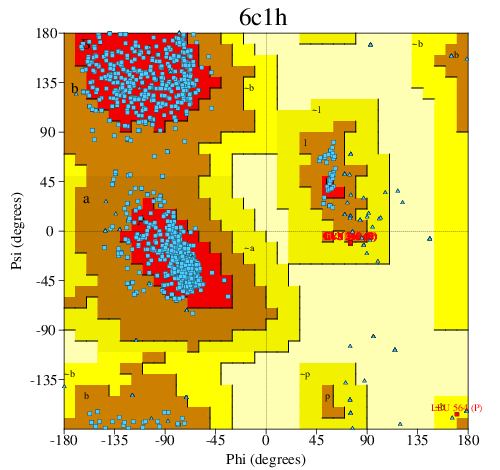
PROCHECK
|
|
|
|
|
|
Headers
|
|
|
|
References
|
|
|
|
|
|

|
|
P68135
(ACTS_RABIT) -
Actin, alpha skeletal muscle from Oryctolagus cuniculus
|
|
|
|
Seq:
Struc:
|
|
|
|
377 a.a.
375 a.a.
|
|

|

|

|
|
|
|
|
|
|
|
|
|
|
|
|
|
|
|
|
Enzyme class:
|
|
Chains A, B, C, D, E:
E.C.3.6.4.-
- ?????
|
|
|
|
|
|
|
|
|
|
|
|
|
|
|
|
|
|
|
 |
|
|
|
|
|
|
| |
|
|
Proc Natl Acad Sci U S A
115:1292-1297
(2018)
|
|
PubMed id:
|
|
|
|
|
|
| |
|
High-resolution cryo-EM structures of actin-bound myosin states reveal the mechanism of myosin force sensing.
|
|
A.Mentes,
A.Huehn,
X.Liu,
A.Zwolak,
R.Dominguez,
H.Shuman,
E.M.Ostap,
C.V.Sindelar.
|
|
|
|
|
| |
ABSTRACT
|
|
|
|
| |
|
|
Myosins adjust their power outputs in response to mechanical loads in an
isoform-dependent manner, resulting in their ability to dynamically adapt to a
range of motile challenges. Here, we reveal the structural basis for
force-sensing based on near-atomic resolution structures of one rigor and two
ADP-bound states of myosin-IB (myo1b) bound to actin, determined by
cryo-electron microscopy. The two ADP-bound states are separated by a 25°
rotation of the lever. The lever of the first ADP state is rotated toward the
pointed end of the actin filament and forms a previously unidentified interface
with the N-terminal subdomain, which constitutes the upper half of the
nucleotide-binding cleft. This pointed-end orientation of the lever blocks ADP
release by preventing the N-terminal subdomain from the pivoting required to
open the nucleotide binding site, thus revealing how myo1b is inhibited by
mechanical loads that restrain lever rotation. The lever of the second ADP state
adopts a rigor-like orientation, stabilized by class-specific elements of myo1b.
We identify a role for this conformation as an intermediate in the ADP release
pathway. Moreover, comparison of our structures with other myosins reveals
structural diversity in the actomyosin binding site, and we reveal the
high-resolution structure of actin-bound phalloidin, a potent stabilizer of
filamentous actin. These results provide a framework to understand the spectrum
of force-sensing capacities among the myosin superfamily.
|
|
|
|
|
|
|
|
|
|
|
|
|
|
|
|
|
|
 |
 |
 |
|
| |


 Links
Links


