 |
PDBsum entry 6bap

|
|
|
|
|
|

|

|

|

|
|

|
|

|
|

|
|

|
|

|
|
|
 |

|

|
|
|
|
|
|
|
|
|
|
|
|
|
|
|
|
|
|
|
|
|
|
|
|
|
|
|
|
|
|
|
|
|
|
Signaling protein
|
PDB id
|
|
|
|
6bap
|
|
|
|
|
|
|
|
|
|
|
|
|
|
|

|

|

|
|
|
|
|
|
|
|
|
Enzyme class:
|
|
E.C.2.7.13.3
- histidine kinase.
|
|
|
|
|
|
|
Reaction:
|
|
ATP + protein L-histidine = ADP + protein N-phospho-L-histidine
|
|
|
|
|
|
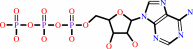 ATP
ATP
|
+
|
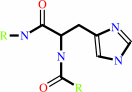 protein L-histidine
|
=
|
 ADP
ADP
|
+
|
protein N-phospho-L-histidine
|
|
|
|
|
|
|
|
|
|
|
|
|
Molecule diagrams generated from .mol files obtained from the
KEGG ftp site
|
|
|
|
|
|
|
|
|
|
|
|
|
|
 |
|
|
|
|
|
|
| |
|
|
| |
|
|
IUCrJ
5:619-634
(2018)
|
|
PubMed id:
|
|
|
|
|
|
| |
|
Structural basis for light control of cell development revealed by crystal structures of a myxobacterial phytochrome.
|
|
N.C.Woitowich,
A.S.Halavaty,
P.Waltz,
C.Kupitz,
J.Valera,
G.Tracy,
K.D.Gallagher,
E.Claesson,
T.Nakane,
S.Pandey,
G.Nelson,
R.Tanaka,
E.Nango,
E.Mizohata,
S.Owada,
K.Tono,
Y.Joti,
A.C.Nugent,
H.Patel,
A.Mapara,
J.Hopkins,
P.Duong,
D.Bizhga,
S.E.Kovaleva,
R.St Peter,
C.N.Hernandez,
W.B.Ozarowski,
S.Roy-Chowdhuri,
J.H.Yang,
P.Edlund,
H.Takala,
J.Ihalainen,
J.Brayshaw,
T.Norwood,
I.Poudyal,
P.Fromme,
J.C.H.Spence,
K.Moffat,
S.Westenhoff,
M.Schmidt,
E.A.Stojković.
|
|
|
|
|
| |
ABSTRACT
|
|
|
|
| |
|
|
Phytochromes are red-light photoreceptors that were first characterized in
plants, with homologs in photosynthetic and non-photosynthetic bacteria known as
bacteriophytochromes (BphPs). Upon absorption of light, BphPs interconvert
between two states denoted Pr and Pfr with distinct absorption spectra in the
red and far-red. They have recently been engineered as enzymatic photoswitches
for fluorescent-marker applications in non-invasive tissue imaging of mammals.
This article presents cryo- and room-temperature crystal structures of the
unusual phytochrome from the non-photosynthetic myxo-bacterium Stigmatella
aurantiaca (SaBphP1) and reveals its role in the fruiting-body formation of
this photomorphogenic bacterium. SaBphP1 lacks a conserved histidine (His) in
the chromophore-binding domain that stabilizes the Pr state in the classical
BphPs. Instead it contains a threonine (Thr), a feature that is restricted to
several myxobacterial phytochromes and is not evolutionarily understood. SaBphP1
structures of the chromophore binding domain (CBD) and the complete photosensory
core module (PCM) in wild-type and Thr-to-His mutant forms reveal details of the
molecular mechanism of the Pr/Pfr transition associated with the physiological
response of this myxobacterium to red light. Specifically, key structural
differences in the CBD and PCM between the wild-type and the Thr-to-His mutant
involve essential chromophore contacts with proximal amino acids, and point to
how the photosignal is transduced through the rest of the protein, impacting the
essential enzymatic activity in the photomorphogenic response of this
myxobacterium.
|
|
|
|
|
|
|
|
|
|
|
|
|
|
|
|
|
|
 |
 |
 |
|


 Links
Links


