 |
PDBsum entry 6ba4
|
|

|
|
PDB id:
|
|
|
|
| Name: |
|
Transferase
|
|
|
Title:
|
|
Crystal structure of myst acetyltransferase domain in complex with acetyl-coa cofactor
|
|
Structure:
|
|
Histone acetyltransferase kat8. Chain: a. Synonym: lysine acetyltransferase 8,moz,ybf2/sas3,sas2 and tip60 protein 1,hmof. Engineered: yes
|
|
Source:
|
|
Homo sapiens. Human. Organism_taxid: 9606. Gene: kat8, mof, myst1, pp7073. Expressed in: escherichia coli. Expression_system_taxid: 562
|
|
Resolution:
|
|
|
1.95Å
|
R-factor:
|
0.186
|
R-free:
|
0.213
|
|
|
Authors:
|
|
S.J.Hermans,M.C.Chung,T.S.Peat,J.B.Baell,T.Thomas,M.W.Parker
|
|
Key ref:
|
|
J.B.Baell
et al.
(2018).
Inhibitors of histone acetyltransferases KAT6A/B induce senescence and arrest tumour growth.
Nature,
560,
253-257.
PubMed id:
DOI:
|
|
|
Date:
|
|
|
12-Oct-17
|
Release date:
|
01-Aug-18
|
|
|
|
|
|
|
PROCHECK
|

|
|
|
|
|
Headers
|
|
|
|
References
|
|
|
|
|
|

|
|
Q9H7Z6
(KAT8_HUMAN) -
Histone acetyltransferase KAT8 from Homo sapiens
|
|
|
|
Seq:
Struc:
|
|
|
|
458 a.a.
268 a.a.*
|
|

|

|

|
|
|
|
|
|
|
|
|
|
|
Key: |
 |
PfamA domain |
|
|
 |
Secondary structure |
|
|
*
PDB and UniProt seqs differ
at 8 residue positions (black
crosses)
|
|
|
|
|
|
|
|
|
|
|
|
|
Enzyme class 1:
|
|
E.C.2.3.1.-
- ?????
|
|
|
|
|
|
|
Enzyme class 2:
|
|
E.C.2.3.1.48
- histone acetyltransferase.
|
|
|
|
|
|
|
Reaction:
|
|
L-lysyl-[protein] + acetyl-CoA = N6-acetyl-L-lysyl-[protein] + CoA + H+
|
|
|
|
|
|
L-lysyl-[protein]
Bound ligand (Het Group name = )
corresponds exactly
|
+
|
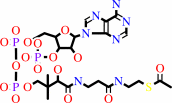 acetyl-CoA
|
=
|
N(6)-acetyl-L-lysyl-[protein]
|
+
|
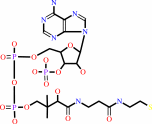 CoA
CoA
|
+
|
H(+)
|
|
|
|
|
|
|
|
|
|
|
|
|
Note, where more than one E.C. class is given (as above), each may
correspond to a different protein domain or, in the case of polyprotein
precursors, to a different mature protein.
|
|
|
|
Molecule diagrams generated from .mol files obtained from the
KEGG ftp site
|
|
|
|
|
|
|
|
|
|
|
|
|
|
 |
|
|
|
|
|
|
| |
|
|
| |
|
DOI no:
|
Nature
560:253-257
(2018)
|
|
PubMed id:
|
|
|
|
|
|
| |
|
Inhibitors of histone acetyltransferases KAT6A/B induce senescence and arrest tumour growth.
|
|
J.B.Baell,
D.J.Leaver,
S.J.Hermans,
G.L.Kelly,
M.S.Brennan,
N.L.Downer,
N.Nguyen,
J.Wichmann,
H.M.McRae,
Y.Yang,
B.Cleary,
H.R.Lagiakos,
S.Mieruszynski,
G.Pacini,
H.K.Vanyai,
M.I.Bergamasco,
R.E.May,
B.K.Davey,
K.J.Morgan,
A.J.Sealey,
B.Wang,
N.Zamudio,
S.Wilcox,
A.L.Garnham,
B.N.Sheikh,
B.J.Aubrey,
K.Doggett,
M.C.Chung,
M.de Silva,
J.Bentley,
P.Pilling,
M.Hattarki,
O.Dolezal,
M.L.Dennis,
H.Falk,
B.Ren,
S.A.Charman,
K.L.White,
J.Rautela,
A.Newbold,
E.D.Hawkins,
R.W.Johnstone,
N.D.Huntington,
T.S.Peat,
J.K.Heath,
A.Strasser,
M.W.Parker,
G.K.Smyth,
I.P.Street,
B.J.Monahan,
A.K.Voss,
T.Thomas.
|
|
|
|
|
| |
ABSTRACT
|
|
|
|
| |
|
|
Acetylation of histones by lysine acetyltransferases (KATs) is essential for
chromatin organization and function1. Among the genes coding for the
MYST family of KATs (KAT5-KAT8) are the oncogenes KAT6A (also known as MOZ) and
KAT6B (also known as MORF and QKF)2,3. KAT6A has essential roles in
normal haematopoietic stem cells4-6 and is the target of recurrent
chromosomal translocations, causing acute myeloid leukaemia7,8.
Similarly, chromosomal translocations in KAT6B have been identified in diverse
cancers8. KAT6A suppresses cellular senescence through the regulation
of suppressors of the CDKN2A locus9,10, a function that requires its
KAT activity10. Loss of one allele of KAT6A extends the median
survival of mice with MYC-induced lymphoma from 105 to 413 days11.
These findings suggest that inhibition of KAT6A and KAT6B may provide a
therapeutic benefit in cancer. Here we present highly potent, selective
inhibitors of KAT6A and KAT6B, denoted WM-8014 and WM-1119. Biochemical and
structural studies demonstrate that these compounds are reversible competitors
of acetyl coenzyme A and inhibit MYST-catalysed histone acetylation. WM-8014 and
WM-1119 induce cell cycle exit and cellular senescence without causing DNA
damage. Senescence is INK4A/ARF-dependent and is accompanied by changes in gene
expression that are typical of loss of KAT6A function. WM-8014 potentiates
oncogene-induced senescence in vitro and in a zebrafish model of hepatocellular
carcinoma. WM-1119, which has increased bioavailability, arrests the progression
of lymphoma in mice. We anticipate that this class of inhibitors will help to
accelerate the development of therapeutics that target gene transcription
regulated by histone acetylation.
|
|
|
|
|
|
|
|
|
|
|
|
|
|
|
|
|
|
 |
 |
 |
|


 Links
Links


