 |
PDBsum entry 6b0v

|
|
|
|
|
|

|

|

|

|
|

|
|

|
|

|
|

|
|

|
|
|
 |

|

|
|
|
|
|
|
|
|
|
|
|
|
|
|
|
|
|
|
|
|
|
|
|
|
|
|
|
|
|
|
|
|
|
|
Signaling protein
|
PDB id
|
|
|
|
6b0v
|
|
|
|
|
|
|
|
|
|
|
|
|
|
|

|

|

|
|
|
|
|
|
|
PDB id:
|
|
|
|
| Name: |
|
Signaling protein
|
|
|
Title:
|
|
Crystal structure of small molecule ars-107 covalently bound to k-ras g12c
|
|
Structure:
|
|
Gtpase kras. Chain: a, b. Fragment: unp residues 1-169. Synonym: k-ras 2,ki-ras,c-k-ras,c-ki-ras. Engineered: yes. Mutation: yes
|
|
Source:
|
|
Homo sapiens. Human. Organism_taxid: 9606. Gene: kras, kras2, rask2. Expressed in: escherichia coli. Expression_system_taxid: 469008.
|
|
Resolution:
|
|
|
1.29Å
|
R-factor:
|
0.184
|
R-free:
|
0.218
|
|
|
Authors:
|
|
R.Hansen,U.Peters,A.Babbar,Y.Chen,J.Feng,M.R.Janes,L.-S.Li,P.Ren, Y.Liu,P.P.Zarrinkar
|
|
Key ref:
|
|
R.Hansen
et al.
(2018).
The reactivity-driven biochemical mechanism of covalent KRASG12C inhibitors.
Nat Struct Mol Biol,
25,
454-462.
PubMed id:
DOI:
|
|
|
Date:
|
|
|
15-Sep-17
|
Release date:
|
16-May-18
|
|
|
|
|
|
|
PROCHECK
|

|
|
|
|
|
Headers
|
|
|
|
References
|
|
|
|
|
|

|
|
P01116
(RASK_HUMAN) -
GTPase KRas from Homo sapiens
|
|
|
|
Seq:
Struc:
|
|
|
|
189 a.a.
167 a.a.*
|
|

|

|
|
|
|
|
|
|
|
|
|
|
|
Key: |
 |
PfamA domain |
|
|
 |
Secondary structure |
|
|
*
PDB and UniProt seqs differ
at 9 residue positions (black
crosses)
|
|
|
|
|
|
|
|
|
|
|
|
|
Enzyme class:
|
|
E.C.3.6.5.2
- small monomeric GTPase.
|
|
|
|
|
|
|
Reaction:
|
|
GTP + H2O = GDP + phosphate + H+
|
|
|
|
|
|
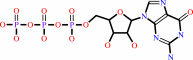 GTP
GTP
|
+
|
H2O
|
=
|
GDP
Bound ligand (Het Group name = )
corresponds exactly
|
+
|
 phosphate
|
+
|
H(+)
|
|
|
|
|
|
|
|
|
|
|
|
|
Molecule diagrams generated from .mol files obtained from the
KEGG ftp site
|
|
|
|
|
|
|
|
|
|
|
|
|
|
 |
|
|
|
|
|
|
| |
|
|
| |
|
DOI no:
|
Nat Struct Mol Biol
25:454-462
(2018)
|
|
PubMed id:
|
|
|
|
|
|
| |
|
The reactivity-driven biochemical mechanism of covalent KRASG12C inhibitors.
|
|
R.Hansen,
U.Peters,
A.Babbar,
Y.Chen,
J.Feng,
M.R.Janes,
L.S.Li,
P.Ren,
Y.Liu,
P.P.Zarrinkar.
|
|
|
|
|
| |
ABSTRACT
|
|
|
|
| |
|
|
Activating mutations in KRAS are among the most common tumor driver mutations.
Until recently, KRAS had been considered undruggable with small molecules; the
discovery of the covalent KRASG12C inhibitors ARS-853 and ARS-1620
has demonstrated that it is feasible to inhibit KRAS with high potency in cells
and animals. Although the biological activity of these inhibitors has been
described, the biochemical mechanism of how the compounds achieve potent
inhibition remained incompletely understood. We now show that the activity of
ARS-853 and ARS-1620 is primarily driven by KRAS-mediated catalysis of the
chemical reaction with Cys12 in human KRASG12C, while the reversible
binding affinity is weak, in the hundreds of micromolar or higher range. The
mechanism resolves how an induced, shallow and dynamic pocket not expected to
support high-affinity binding of small molecules can nevertheless be targeted
with potent inhibitors and may be applicable to other targets conventionally
considered undruggable.
|
|
|
|
|
|
|
|
|
|
|
|
|
|
|
|
|
|
 |
 |
 |
|


 Links
Links


