|
PDBsum entry 6a7c

|
|
|
|
|
|

|

|

|

|
|

|
|

|
|

|
|

|
|
|
 |

|

|
|
|
|
|
|
|
|
|
|
|
|
|
|
|
|
|
|
|
|
|
|
|
|
|
|
|
|
|
|
|
|
|
Oxidoreductase
|
PDB id
|
|
|
|
6a7c
|
|
|
|
|
|
|
|
|
|
|
|
|
|
|

|

|

|
|
|
|
|
|
|
|
|
Enzyme class:
|
|
E.C.1.5.1.3
- dihydrofolate reductase.
|
|
|
|
|
|
|
Pathway:
|
|
Folate Coenzymes
|
|
|
|
|
|
Reaction:
|
|
(6S)-5,6,7,8-tetrahydrofolate + NADP+ = 7,8-dihydrofolate + NADPH + H+
|
|
|
|
|
|
(6S)-5,6,7,8-tetrahydrofolate
|
+
|
NADP(+)
Bound ligand (Het Group name = )
corresponds exactly
|
=
|
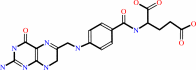 7,8-dihydrofolate
|
+
|
 NADPH
NADPH
|
+
|
H(+)
|
|
|
|
|
|
|
|
|
|
|
|
|
Molecule diagrams generated from .mol files obtained from the
KEGG ftp site
|
|
|
|
|
|
|
|
|
|
|
|
|
|
 |
|
|
|
|
|
|
| |
|
|
| |
|
DOI no:
|
ACS Med Chem Lett
9:1235-1240
(2018)
|
|
PubMed id:
|
|
|
|
|
|
| |
|
Hybrid Inhibitors of Malarial Dihydrofolate Reductase with Dual Binding Modes That Can Forestall Resistance.
|
|
B.Tarnchompoo,
P.Chitnumsub,
A.Jaruwat,
P.J.Shaw,
J.Vanichtanankul,
S.Poen,
R.Rattanajak,
C.Wongsombat,
A.Tonsomboon,
S.Decharuangsilp,
T.Anukunwithaya,
U.Arwon,
S.Kamchonwongpaisan,
Y.Yuthavong.
|
|
|
|
|
| |
ABSTRACT
|
|
|
|
| |
|
|
The S108N mutation of dihydrofolate reductase (DHFR) renders Plasmodium
falciparum malaria parasites resistant to pyrimethamine through steric clash
with the rigid side chain of the inhibitor. Inhibitors with flexible side chains
can avoid this clash and retain effectiveness against the mutant. However, other
mutations such as N108S reversion confer resistance to flexible inhibitors. We
designed and synthesized hybrid inhibitors with two structural types in a single
molecule, which are effective against both wild-type and multiple mutants of
P. falciparum through their selective target binding, as demonstrated by
X-ray crystallography. Furthermore, the hybrid inhibitors can forestall the
emergence of new resistant mutants, as shown by selection of mutants resistant
to hybrid compound BT1 from a diverse PfDHFR random mutant library
expressed in a surrogate bacterial system. These results show that it is
possible to develop effective antifolate antimalarials to which the range of
parasite resistance mutations is greatly reduced.
|
|
|
|
|
|
|
|
|
|
|
|
|
|
|
|
|
|
 |
 |
 |
|


 Links
Links