 |
PDBsum entry 5ueh

|
|
|
|
|
|

|

|

|

|
|

|
|

|
|

|
|
|
 |

|

|
|
|
|
|
|
|
|
|
|
|
|
|
|
|
|
|
|
|
|
|
|
|
|
|
|
|
|
|
|
|
|
Transferase/oxidoreductase
|
PDB id
|
|
|
|
5ueh
|
|
|
|
|
|
|
|
|
|
|
|
|
|
|

|

|

|
|
|
|
|
|
|
PDB id:
|
|
|
|
| Name: |
|
Transferase/oxidoreductase
|
|
|
Title:
|
|
Structure of gsto1 covalently conjugated to quinolinic acid fluorosulfate
|
|
Structure:
|
|
Glutathione s-transferase omega-1. Chain: a. Synonym: gsto-1,glutathione s-transferase omega 1-1,gsto 1-1, glutathione-dependent dehydroascorbate reductase,monomethylarsonic acid reductase,mma(v) reductase,s-(phenacyl)glutathione reductase, spg-r. Engineered: yes
|
|
Source:
|
|
Homo sapiens. Human. Organism_taxid: 9606. Gene: gsto1, gsttlp28. Expressed in: escherichia coli. Expression_system_taxid: 562
|
|
Resolution:
|
|
|
2.00Å
|
R-factor:
|
0.173
|
R-free:
|
0.230
|
|
|
Authors:
|
|
D.E.Mortenson,I.A.Wilson,J.W.Kelly
|
|
Key ref:
|
|
D.E.Mortenson
et al.
(2018).
"Inverse Drug Discovery" Strategy To Identify Proteins That Are Targeted by Latent Electrophiles As Exemplified by Aryl Fluorosulfates.
J Am Chem Soc,
140,
200-210.
PubMed id:
|
|
|
Date:
|
|
|
02-Jan-17
|
Release date:
|
17-Jan-18
|
|
|
|
|
|
|
PROCHECK
|

|
|
|
|
|
Headers
|
|
|
|
References
|
|
|
|
|
|

|
|
P78417
(GSTO1_HUMAN) -
Glutathione S-transferase omega-1 from Homo sapiens
|
|
|
|
Seq:
Struc:
|
|
|
|
241 a.a.
239 a.a.
|
|

|

|
|
|
|
|
|
|
|
|
|
|
|
Key: |
 |
PfamA domain |
|
|
 |
Secondary structure |
|
|
|
|
|
|
|
|
|
|
|
|
|
Enzyme class 2:
|
|
E.C.1.20.4.2
- methylarsonate reductase.
|
|
|
|
|
|
|
Reaction:
|
|
methylarsonate + 2 glutathione + H+ = methylarsonous acid + glutathione disulfide + H2O
|
|
|
|
|
|
 methylarsonate
|
+
|
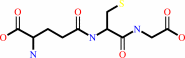 2
×
glutathione
2
×
glutathione
|
+
|
H(+)
|
=
|
methylarsonous acid
|
+
|
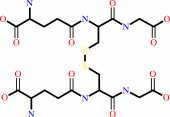 glutathione disulfide
|
+
|
H2O
|
|
|
|
|
|
|
|
|
|
Enzyme class 3:
|
|
E.C.1.8.5.1
- glutathione dehydrogenase (ascorbate).
|
|
|
|
|
|
|
Reaction:
|
|
L-dehydroascorbate + 2 glutathione = glutathione disulfide + L-ascorbate
|
|
|
|
|
|
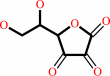 L-dehydroascorbate
|
+
|
2
×
glutathione
Bound ligand (Het Group name = )
matches with 50.00% similarity
|
=
|
glutathione disulfide
|
+
|
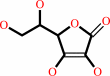 L-ascorbate
|
|
|
|
|
|
|
|
|
|
Enzyme class 4:
|
|
E.C.2.5.1.18
- glutathione transferase.
|
|
|
|
|
|
|
Reaction:
|
|
RX + glutathione = an S-substituted glutathione + a halide anion + H+
|
|
|
|
|
|
 RX
RX
|
+
|
2
×
glutathione
|
=
|
S-substituted glutathione
|
+
|
halide anion
|
+
|
H(+)
|
|
|
|
|
|
|
|
|
|
|
|
|
Note, where more than one E.C. class is given (as above), each may
correspond to a different protein domain or, in the case of polyprotein
precursors, to a different mature protein.
|
|
|
|
Molecule diagrams generated from .mol files obtained from the
KEGG ftp site
|
|
|
|
|
|
|
|
|
|
|
|
|
|
 |
|
|
|
|
|
|
| |
|
|
| |
|
|
J Am Chem Soc
140:200-210
(2018)
|
|
PubMed id:
|
|
|
|
|
|
| |
|
"Inverse Drug Discovery" Strategy To Identify Proteins That Are Targeted by Latent Electrophiles As Exemplified by Aryl Fluorosulfates.
|
|
D.E.Mortenson,
G.J.Brighty,
L.Plate,
G.Bare,
W.Chen,
S.Li,
H.Wang,
B.F.Cravatt,
S.Forli,
E.T.Powers,
K.B.Sharpless,
I.A.Wilson,
J.W.Kelly.
|
|
|
|
|
| |
ABSTRACT
|
|
|
|
| |
|
|
Drug candidates are generally discovered using biochemical screens employing an
isolated target protein or by utilizing cell-based phenotypic assays. Both
noncovalent and covalent hits emerge from such endeavors. Herein, we exemplify
an "Inverse Drug Discovery" strategy in which organic compounds of
intermediate complexity harboring weak, but activatable, electrophiles are
matched with the protein(s) they react with in cells or cell lysate. An alkyne
substructure in each candidate small molecule enables affinity
chromatography-mass spectrometry, which produces a list of proteins that each
distinct compound reacts with. A notable feature of this approach is that it is
agnostic with respect to the cellular proteins targeted. To illustrate this
strategy, we employed aryl fluorosulfates, an underexplored class of sulfur(VI)
halides, that are generally unreactive unless activated by protein binding.
Reversible aryl fluorosulfate binding, correct juxtaposition of protein side
chain functional groups, and transition-state stabilization of the S(VI)
exchange reaction all seem to be critical for conjugate formation. The aryl
fluorosulfates studied thus far exhibit chemoselective reactivity toward Lys
and, particularly, Tyr side chains, and can be used to target nonenzymes (e.g.,
a hormone carrier or a small-molecule carrier protein) as well as enzymes. The
"Inverse Drug Discovery" strategy should be particularly attractive as
a means to explore latent electrophiles not typically used in medicinal
chemistry efforts, until one reacts with a protein target of exceptional
interest. Structure-activity data can then be used to enhance the selectivity of
conjugate formation or the covalent probe can be used as a competitor to develop
noncovalent drug candidates. Here we use the "Inverse Drug Discovery"
platform to identify and validate covalent ligands for 11 different human
proteins. In the case of one of these proteins, we have identified and validated
a small-molecule probe for the first time.
|
|
|
|
|
|
|
|
|
|
|
|
|
|
|
|
|
|
 |
 |
 |
|


 Links
Links


