 |
PDBsum entry 5r9h
 |
|
|
|
|
|
|
Enzyme class:
|
|
E.C.2.7.11.24
- mitogen-activated protein kinase.
|
|
|
|
|
|
|
Reaction:
|
|
|
1.
|
L-seryl-[protein] + ATP = O-phospho-L-seryl-[protein] + ADP + H+
|
|
2.
|
L-threonyl-[protein] + ATP = O-phospho-L-threonyl-[protein] + ADP + H+
|
|
|
|
|
|
|
L-seryl-[protein]
|
+
|
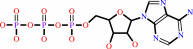 ATP
ATP
|
=
|
O-phospho-L-seryl-[protein]
|
+
|
 ADP
ADP
|
+
|
H(+)
|
|
|
|
|
|
|
L-threonyl-[protein]
|
+
|
ATP
|
=
|
O-phospho-L-threonyl-[protein]
|
+
|
ADP
|
+
|
H(+)
|
|
|
|
|
|
|
|
|
|
|
|
|
Molecule diagrams generated from .mol files obtained from the
KEGG ftp site
|
|
|
|
|
|
|
|
|
|
|
|
|
|
 |
|
|
|
|
|
|
| |
|
|
| |
|
DOI no:
|
J Med Chem
63:7559-7568
(2020)
|
|
PubMed id:
|
|
|
|
|
|
| |
|
Mining the PDB for Tractable Cases Where X-ray Crystallography Combined with Fragment Screens Can Be Used to Systematically Design Protein-Protein Inhibitors: Two Test Cases Illustrated by IL1β-IL1R and p38α-TAB1 Complexes.
|
|
C.Nichols,
J.Ng,
A.Keshu,
G.Kelly,
M.R.Conte,
M.S.Marber,
F.Fraternali,
G.F.De Nicola.
|
|
|
|
|
| |
ABSTRACT
|
|
|
|
| |
|
|
Nowadays, it is possible to combine X-ray crystallography and fragment screening
in a medium throughput fashion to chemically probe the surfaces used by proteins
to interact and use the outcome of the screens to systematically design
protein-protein inhibitors. To prove it, we first performed a bioinformatics
analysis of the Protein Data Bank protein complexes, which revealed over 400
cases where the crystal lattice of the target in the free form is such that
large portions of the interacting surfaces are free from lattice contacts and
therefore accessible to fragments during soaks. Among the tractable complexes
identified, we then performed single fragment crystal screens on two particular
interesting cases: the Il1β-ILR and p38α-TAB1 complexes. The result of the
screens showed that fragments tend to bind in clusters, highlighting the
small-molecule hotspots on the surface of the target protein. In most of the
cases, the hotspots overlapped with the binding sites of the interacting
proteins.
|
|
|
|
|
|
|
|
|
|
|
|
|
|
|
|
|
|
 |
 |
 |
|


 Links
Links


