 |
PDBsum entry 5o2f
|
|

|
|
PDB id:
|
|
|
|
| Name: |
|
Hydrolase
|
|
|
Title:
|
|
Crystal structure of ndm-1 in complex with hydrolyzed ampicillin - new refinement
|
|
Structure:
|
|
Metallo-beta-lactamase type 2. Chain: a, b. Synonym: b2 metallo-beta-lactamase,beta-lactamase type ii,metallo- beta-lactamase ndm-1,metallo-beta-lactamase type ii,new delhi metallo-beta-lactamase-1,ndm-1. Engineered: yes
|
|
Source:
|
|
Klebsiella pneumoniae. Organism_taxid: 573. Gene: blandm-1. Expressed in: escherichia coli. Expression_system_taxid: 562
|
|
Resolution:
|
|
|
2.01Å
|
R-factor:
|
0.135
|
R-free:
|
0.182
|
|
|
Authors:
|
|
J.E.Raczynska,I.G.Shabalin,M.Jaskolski,W.Minor,A.Wlodawer
|
|
Key ref:
|
|
J.E.Raczynska
et al.
(2018).
A close look onto structural models and primary ligands of metallo-β-lactamases.
Drug Resist Updat,
40,
1.
PubMed id:
|
|
|
Date:
|
|
|
20-May-17
|
Release date:
|
26-Dec-18
|
|
|
|
|
|
|
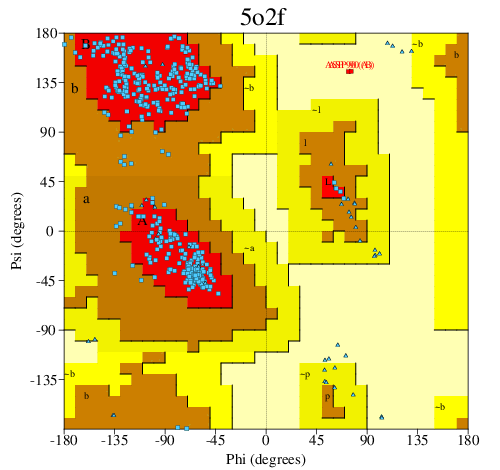
PROCHECK
|
|
|
|
|
|
Headers
|
|
|
|
References
|
|
|
|
|
|

|
|
C7C422
(BLAN1_KLEPN) -
Metallo-beta-lactamase type 2 from Klebsiella pneumoniae
|
|
|
|
Seq:
Struc:
|
|
|
|
270 a.a.
243 a.a.*
|
|

|

|

|
|
|
|
|
|
|
|
|
|
|
Key: |
 |
PfamA domain |
|
|
 |
Secondary structure |
|
|
*
PDB and UniProt seqs differ
at 1 residue position (black
cross)
|
|
|
|
|
|
|
|
|
|
|
|
|
|
|
|
|
 |
|
|
|
|
|
|
| |
|
|
Drug Resist Updat
40:1
(2018)
|
|
PubMed id:
|
|
|
|
|
|
| |
|
A close look onto structural models and primary ligands of metallo-β-lactamases.
|
|
J.E.Raczynska,
I.G.Shabalin,
W.Minor,
A.Wlodawer,
M.Jaskolski.
|
|
|
|
|
| |
ABSTRACT
|
|
|
|
| |
|
|
β-Lactamases are hydrolytic enzymes capable of opening the β-lactam ring of
antibiotics such as penicillin, thus endowing the bacteria that produce them
with antibiotic resistance. Of particular medical concern are
metallo-β-lactamases (MBLs), with an active site built around coordinated Zn
cations. MBLs are pan-reactive enzymes that can break down almost all classes of
β-lactams, including such last-resort antibiotics as carbapenems. They are not
only broad-spectrum-reactive but are often plasmid-borne (e.g., the New Delhi
enzyme, NDM), and can spread horizontally even among unrelated bacteria.
Acquired MBLs are encoded by mobile genetic elements, which often include other
resistance genes, making the microbiological situation particularly alarming.
There is an urgent need to develop MBL inhibitors in order to rescue our
antibiotic armory. A number of such efforts have been undertaken, most notably
using the 3D structures of various MBLs as drug-design targets. Structure-guided
drug discovery depends on the quality of the structures that are collected in
the Protein Data Bank (PDB) and on the consistency of the information in
dedicated β-lactamase databases. We conducted a careful review of the crystal
structures of class B β-lactamases, concluding that the quality of these
structures varies widely, especially in the regions where small molecules
interact with the macromolecules. In a number of examples the interpretation of
the bound ligands (e.g., inhibitors, substrate/product analogs) is doubtful or
even incorrect, and it appears that in some cases the modeling of ligands was
not supported by electron density. For ten MBL structures, alternative
interpretations of the original diffraction data could be proposed and the new
models have been deposited in the PDB. In four cases, these models, prepared
jointly with the authors of the original depositions, superseded the previous
deposits. This review emphasizes the importance of critical assessment of
structural models describing key drug design targets at the level of the raw
experimental data. Since the structures reviewed here are the basis for ongoing
design of new MBL inhibitors, it is important to identify and correct the
problems with ambiguous crystallographic interpretations, thus enhancing
reproducibility in this highly medically relevant area.
|
|
|
|
|
|
|
|
|
|
|
|
|
|
|
|
|
|
 |
 |
 |
|


 Links
Links


