 |
PDBsum entry 5o0c
|
|

|
|
PDB id:
|
|
|
|
| Name: |
|
Transferase
|
|
|
Title:
|
|
Crystal structure of phosphopantetheine adenylyltransferase from mycobacterium abcessus in complex with 3-(3-methyl-1h-indol-1-yl) propanoic acid (fragment 3)
|
|
Structure:
|
|
Phosphopantetheine adenylyltransferase. Chain: a, b, c. Synonym: dephospho-coa pyrophosphorylase,pantetheine-phosphate adenylyltransferase,ppat. Engineered: yes
|
|
Source:
|
|
Mycobacterium abscessus (strain atcc 19977 / dsm 44196 / cip 104536 / jcm 13569 / nctc 13031 / tmc 1543). Organism_taxid: 561007. Strain: atcc 19977 / dsm 44196 / cip 104536 / jcm 13569 / nctc 13031 / tmc 1543. Gene: coad, mab_3259c. Expressed in: escherichia coli bl21(de3). Expression_system_taxid: 469008
|
|
Resolution:
|
|
|
1.64Å
|
R-factor:
|
0.190
|
R-free:
|
0.209
|
|
|
Authors:
|
|
S.E.Thomas,S.Y.Kim,V.Mendes,M.Blaszczyk,T.L.Blundell
|
|
Key ref:
|
|
S.E.Thomas
et al.
(2017).
Structural Biology and the Design of New Therapeutics: From HIV and Cancer to Mycobacterial Infections: A Paper Dedicated to John Kendrew.
J Mol Biol,
429,
2677-2693.
PubMed id:
DOI:
|
|
|
Date:
|
|
|
16-May-17
|
Release date:
|
28-Jun-17
|
|
|
|
|
|
|
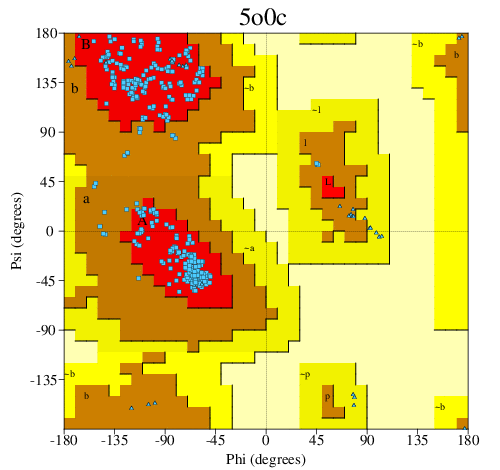
PROCHECK
|
|
|
|
|
|
Headers
|
|
|
|
References
|
|
|
|
|
|

|
|
B1MDL6
(COAD_MYCA9) -
Phosphopantetheine adenylyltransferase from Mycobacteroides abscessus (strain ATCC 19977 / DSM 44196 / CCUG 20993 / CIP 104536 / JCM 13569 / NCTC 13031 / TMC 1543 / L948)
|
|
|
|
Seq:
Struc:
|
|
|
|
161 a.a.
157 a.a.
|
|

|

|
|
|
|
|
|
|
|
|
|
|
|
Key: |
 |
PfamA domain |
|
|
 |
Secondary structure |
|
|
|
|
|
|
|
|
|
|
|
|
|
Enzyme class:
|
|
E.C.2.7.7.3
- pantetheine-phosphate adenylyltransferase.
|
|
|
|
|
|
|
Pathway:
|
|
Coenzyme A Biosynthesis (late stages)
|
|
|
|
|
|
Reaction:
|
|
(R)-4'-phosphopantetheine + ATP + H+ = 3'-dephospho-CoA + diphosphate
|
|
|
|
|
|
(R)-4'-phosphopantetheine
|
+
|
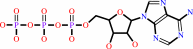 ATP
ATP
|
+
|
H(+)
|
=
|
3'-dephospho-CoA
|
+
|
 diphosphate
|
|
|
|
|
|
|
|
|
|
|
|
|
Molecule diagrams generated from .mol files obtained from the
KEGG ftp site
|
|
|
|
|
|
|
|
|
|
|
|
|
|
 |
|
|
|
|
|
|
| |
|
|
| |
|
DOI no:
|
J Mol Biol
429:2677-2693
(2017)
|
|
PubMed id:
|
|
|
|
|
|
| |
|
Structural Biology and the Design of New Therapeutics: From HIV and Cancer to Mycobacterial Infections: A Paper Dedicated to John Kendrew.
|
|
S.E.Thomas,
V.Mendes,
S.Y.Kim,
S.Malhotra,
B.Ochoa-Montaño,
M.Blaszczyk,
T.L.Blundell.
|
|
|
|
|
| |
ABSTRACT
|
|
|
|
| |
|
|
Interest in applications of protein crystallography to medicine was evident, as
the first high-resolution structures emerged in the 50s and 60s. In Cambridge,
Max Perutz and John Kendrew sought to understand mutations in sickle cell and
other genetic diseases related to hemoglobin, while in Oxford, the group of
Dorothy Hodgkin became interested in long-lasting zinc-insulin crystals for
treatment of diabetes and later considered insulin redesign, as synthetic
insulins became possible. The use of protein crystallography in structure-guided
drug discovery emerged as enzyme structures allowed the identification of
potential inhibitor-binding sites and optimization of interactions of hits using
the structure of the target protein. Early examples of this approach were the
use of the structure of renin to design antihypertensives and the structure of
HIV protease in design of AIDS antivirals. More recently, use of
structure-guided design with fragment-based drug discovery, which reduces the
size of screening libraries by decreasing complexity, has improved ligand
efficiency in drug design and has been used to progress three oncology drugs
through clinical trials to FDA approval. We exemplify current developments in
structure-guided target identification and fragment-based lead discovery with
efforts to develop new antimicrobials for mycobacterial infections.
|
|
|
|
|
|
|
|
|
|
|
|
|
|
|
|
|
|
 |
 |
 |
|


 Links
Links


