|
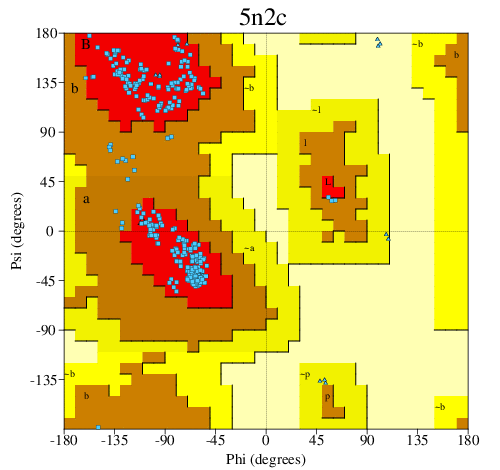
PDBsum entry 5n2c

|
|
|
|
|
|

|

|

|

|
|

|
|

|
|

|
|

|
|
|
 |

|

|
|
|
|
|
|
|
|
|
|
|
|
|
|
|
|
|
|
|
|
|
|
|
|
|
|
|
|
|
|
|
|
|
Transport protein
|
PDB id
|
|
|
|
5n2c
|
|
|
|
|
|
|
|
|
|
|
|
|
|
|

|

|

|
|
|
|
|
|
|
|
|
|
|
|
|
 |
|
|
|
|
|
|
| |
|
DOI no:
|
ACS Infect Dis
3:736-743
(2017)
|
|
PubMed id:
|
|
|
|
|
|
| |
|
Designing Probes for Immunodiagnostics: Structural Insights into an Epitope Targeting Burkholderia Infections.
|
|
R.Capelli,
E.Matterazzo,
M.Amabili,
C.Peri,
A.Gori,
P.Gagni,
M.Chiari,
G.Lertmemongkolchai,
M.Cretich,
M.Bolognesi,
G.Colombo,
L.J.Gourlay.
|
|
|
|
|
| |
ABSTRACT
|
|
|
|
| |
|
|
Structure-based epitope prediction drives the design of diagnostic peptidic
probes to reveal specific antibodies elicited in response to infections. We
previously identified a highly immunoreactive epitope from the
peptidoglycan-associated lipoprotein (Pal) antigen from Burkholderia
pseudomallei, which could also diagnose Burkholderia cepacia infections. Here,
considering the high phylogenetic conservation within Burkholderia species, we
ask whether cross-reactivity can be reciprocally displayed by the synthetic
epitope from B. cenocepacia. We perform comparative analyses of the
conformational preferences and diagnostic performances of the corresponding
epitopes from the two Burkholderia species when presented in the context of the
full-length proteins or as isolated peptides. The effects of conformation on the
diagnostic potential and cross-reactivity of Pal peptide epitopes are
rationalized on the basis of the 1.8 Å crystal structure of B. cenocepacia Pal
and through computational analyses. Our results are discussed in the context of
designing new diagnostic molecules for the early detection of infectious
diseases.
|
|
|
|
|
|
|
|
|
|
|
|
|
|
|
|
|
|
 |
 |
 |
|


 Links
Links