 |
PDBsum entry 5cxx
 |
|
|
|
|
|
|
Enzyme class:
|
|
E.C.3.1.1.73
- feruloyl esterase.
|
|
|
|
|
|
|
Reaction:
|
|
feruloyl-polysaccharide + H2O = ferulate + polysaccharide
|
|
|
|
|
|
feruloyl-polysaccharide
|
+
|
H2O
|
=
|
ferulate
Bound ligand (Het Group name = )
corresponds exactly
|
+
|
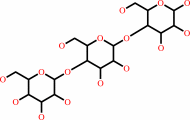 polysaccharide
|
|
|
|
|
|
|
|
|
|
|
|
|
Molecule diagrams generated from .mol files obtained from the
KEGG ftp site
|
|
|
|
|
|
|
|
|
|
|
|
|
|
 |
|
|
|
|
|
|
| |
|
|
| |
|
DOI no:
|
Biochem J
473:839-849
(2016)
|
|
PubMed id:
|
|
|
|
|
|
| |
|
Contributions of a unique β-clamp to substrate recognition illuminates the molecular basis of exolysis in ferulic acid esterases.
|
|
R.J.Gruninger,
C.Cote,
T.A.McAllister,
D.W.Abbott.
|
|
|
|
|
| |
ABSTRACT
|
|
|
|
| |
|
|
Lignocellulosic biomass is a promising renewable resource; however,
deconstruction of this material is still the rate-limiting step. Major obstacles
in the biocatalytic turnover of lignocellulose are ester-linked decorations that
prevent access to primary structural polysaccharides. Enzymes targeting these
esters represent promising biotools for increasing bioconversion efficiency.
Ruminant livestock are unique in their ability to degrade lignocellulose through
the action of their gut microbiome. The anaerobic fungi (phylum
Neocallimastigomycota) are key members of this ecosystem that express a large
repertoire of carbohydrate-active enzymes (CAZymes) with little sequence
identity with characterized CAZymes [Lombard, Golaconda, Drula, Coutinho and
Henrissat (2014) Nucleic Acids Res. 42: , D490-D495]. We have identified a
carbohydrate esterase family 1 (CE1) ferulic acid esterase (FAE) belonging
toAnaeromyces mucronatus(AmCE1/Fae1a), and determined its X-ray structure in
both the presence [1.55 Å (1 Å=0.1 nm)] and absence (1.60 Å) of ferulic
acid. AmCE1 adopts an α/β-hydrolase fold that is structurally conserved with
bacterial FAEs, and possesses a unique loop, termed the β-clamp, that encloses
the ligand. Isothermal titration calorimetry reveals that substrate binding is
driven by enthalpic contributions, which overcomes a large entropic penalty. A
comparative analysis of AmCE1 with related enzymes has uncovered the apparent
structural basis for differential FAE activities targeting cross-linking ferulic
acid conjugates compared with terminal decorations. Based on comparisons to
structurally characterized FAEs, we propose that the β-clamp may define the
structural basis of exolytic activities in FAEs. This provides a structure-based
tool for predicting exolysis and endolysis in CE1. These insights hold promise
for rationally identifying enzymes tailored for bioconversion of biomass with
variations in cell wall composition.
|
|
|
|
|
|
|
|
|
|
|
|
|
|
|
|
|
|
 |
 |
 |
|


 Links
Links


