|
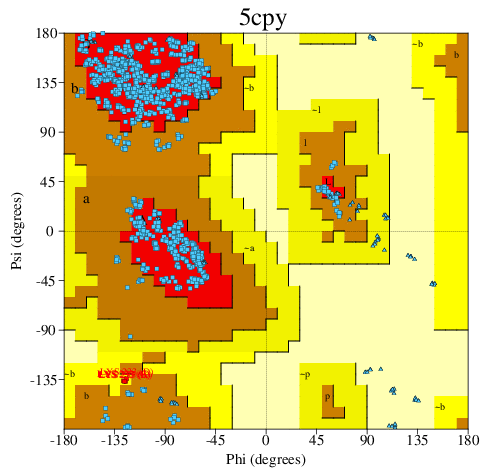
PDBsum entry 5cpy

|
|
|
|
|
|

|

|

|

|
|

|
|

|
|

|
|

|
|

|
|
|
 |

|

|
|
|
|
|
|
|
|
|
|
|
|
|
|
|
|
|
|
|
|
|
|
|
|
|
|
|
|
|
|
|
|
|
|
Viral protein
|
PDB id
|
|
|
|
5cpy
|
|
|
|
|
|
|
|
|
|
|
|
|
|
|

|

|

|
|
|
|
|
|
|
|
|
|
|
|
|
 |
|
|
|
|
|
|
| |
|
DOI no:
|
Plos Pathog
11:e1005104
(2015)
|
|
PubMed id:
|
|
|
|
|
|
| |
|
Structural and Functional Analysis of Murine Polyomavirus Capsid Proteins Establish the Determinants of Ligand Recognition and Pathogenicity.
|
|
M.H.Buch,
A.M.Liaci,
S.D.O'Hara,
R.L.Garcea,
U.Neu,
T.Stehle.
|
|
|
|
|
| |
ABSTRACT
|
|
|
|
| |
|
|
Murine polyomavirus (MuPyV) causes tumors of various origins in newborn mice and
hamsters. Infection is initiated by attachment of the virus to ganglioside
receptors at the cell surface. Single amino acid exchanges in the
receptor-binding pocket of the major capsid protein VP1 are known to drastically
alter tumorigenicity and spread in closely related MuPyV strains. The virus
represents a rare example of differential receptor recognition directly
influencing viral pathogenicity, although the factors underlying these
differences remain unclear. We performed structural and functional analyses of
three MuPyV strains with strikingly different pathogenicities: the
low-tumorigenicity strain RA, the high-pathogenicity strain PTA, and the rapidly
growing, lethal laboratory isolate strain LID. Using ganglioside deficient mouse
embryo fibroblasts, we show that addition of specific gangliosides restores
infectability for all strains, and we uncover a complex relationship between
virus attachment and infection. We identify a new infectious ganglioside
receptor that carries an additional linear [α-2,8]-linked sialic acid. Crystal
structures of all three strains complexed with representative oligosaccharides
from the three main pathways of ganglioside biosynthesis provide the molecular
basis of receptor recognition. All strains bind to a range of sialylated glycans
featuring the central [α-2,3]-linked sialic acid present in the established
receptors GD1a and GT1b, but the presence of additional sialic acids modulates
binding. An extra [α-2,8]-linked sialic acid engages a protein pocket that is
conserved among the three strains, while another, [α-2,6]-linked branching
sialic acid lies near the strain-defining amino acids but can be accommodated by
all strains. By comparing electron density of the oligosaccharides within the
binding pockets at various concentrations, we show that the [α-2,8]-linked
sialic acid increases the strength of binding. Moreover, the amino acid
exchanges have subtle effects on their affinity for the validated receptor GD1a.
Our results indicate that both receptor specificity and affinity influence MuPyV
pathogenesis.
|
|
|
|
|
|
|
|
|
|
|
|
|
|
|
|
|
|
 |
 |
 |
|


 Links
Links