 |
PDBsum entry 5cn5

|
|
|
|
|
|

|

|

|

|
|

|
|

|
|

|
|
|
 |

|

|
|
|
|
|
|
|
|
|
|
|
|
|
|
|
|
|
|
|
|
|
|
|
|
|
|
|
|
|
|
|
|
Oxygen storage
|
PDB id
|
|
|
|
5cn5
|
|
|
|
|
|
|
|
|
|
|
|
|
|
|

|

|

|
|
|
|
|
|
|
PDB id:
|
|
|
|
| Name: |
|
Oxygen storage
|
|
|
Title:
|
|
Ultrafast dynamics in myoglobin: 0 ps time delay
|
|
Structure:
|
|
Myoglobin. Chain: a
|
|
Source:
|
|
Equus caballus. Horse. Organism_taxid: 9796
|
|
Resolution:
|
|
|
1.80Å
|
R-factor:
|
0.178
|
R-free:
|
0.231
|
|
|
Authors:
|
|
T.R.M.Barends,L.Foucar,A.Ardevol,K.J.Nass,A.Aquila,S.Botha,R.B.Doak, K.Falahati,E.Hartmann,M.Hilpert,M.Heinz,M.C.Hoffmann,J.Koefinger, J.Koglin,G.Kovacsova,M.Liang,D.Milathianaki,H.T.Lemke,J.Reinstein, C.M.Roome,R.L.Shoeman,G.J.Williams,I.Burghardt,G.Hummer,S.Boutet, I.Schlichting
|
|
Key ref:
|
|
T.R.Barends
et al.
(2015).
Direct observation of ultrafast collective motions in CO myoglobin upon ligand dissociation.
Science,
350,
445-450.
PubMed id:
DOI:
|
|
|
Date:
|
|
|
17-Jul-15
|
Release date:
|
16-Sep-15
|
|
|
|
|
|
|
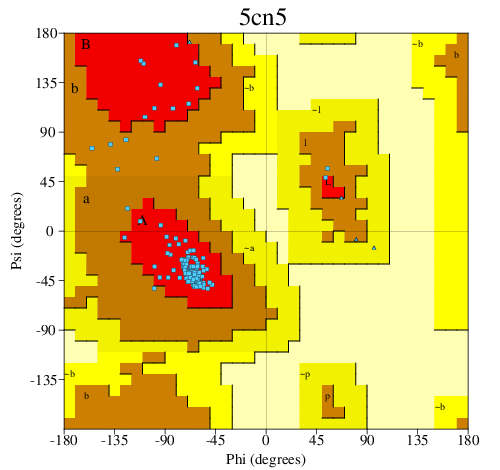
PROCHECK
|
|
|
|
|
|
Headers
|
|
|
|
References
|
|
|
|
|
|

|
|
P68082
(MYG_HORSE) -
Myoglobin from Equus caballus
|
|
|
|
Seq:
Struc:
|
|
|
|
154 a.a.
152 a.a.
|
|

|

|
|
|
|
|
|
|
|
|
|
|
|
Key: |
 |
PfamA domain |
|
|
 |
Secondary structure |
|
 |
CATH domain |
|
|
|
|
|
|
|
|
|
|
|
|
|
|
|
|
|
 |
|
|
|
|
|
|
| |
|
DOI no:
|
Science
350:445-450
(2015)
|
|
PubMed id:
|
|
|
|
|
|
| |
|
Direct observation of ultrafast collective motions in CO myoglobin upon ligand dissociation.
|
|
T.R.Barends,
L.Foucar,
A.Ardevol,
K.Nass,
A.Aquila,
S.Botha,
R.B.Doak,
K.Falahati,
E.Hartmann,
M.Hilpert,
M.Heinz,
M.C.Hoffmann,
J.Köfinger,
J.E.Koglin,
G.Kovacsova,
M.Liang,
D.Milathianaki,
H.T.Lemke,
J.Reinstein,
C.M.Roome,
R.L.Shoeman,
G.J.Williams,
I.Burghardt,
G.Hummer,
S.Boutet,
I.Schlichting.
|
|
|
|
|
| |
ABSTRACT
|
|
|
|
| |
|
|
The hemoprotein myoglobin is a model system for the study of protein dynamics.
We used time-resolved serial femtosecond crystallography at an x-ray
free-electron laser to resolve the ultrafast structural changes in the
carbonmonoxy myoglobin complex upon photolysis of the Fe-CO bond. Structural
changes appear throughout the protein within 500 femtoseconds, with the C, F,
and H helices moving away from the heme cofactor and the E and A helices moving
toward it. These collective movements are predicted by hybrid quantum
mechanics/molecular mechanics simulations. Together with the observed
oscillations of residues contacting the heme, our calculations support the
prediction that an immediate collective response of the protein occurs upon
ligand dissociation, as a result of heme vibrational modes coupling to global
modes of the protein.
|
|
|
|
|
|
|
|
|
|
|
|
|
|
|
|
|
|
 |
 |
 |
|


 Links
Links


