 |
PDBsum entry 5cmu

|
|
|
|
|
|

|

|

|

|
|

|
|

|
|

|
|

|
|
|
 |

|

|
|
|
|
|
|
|
|
|
|
|
|
|
|
|
|
|
|
|
|
|
|
|
|
|
|
|
|
|
|
|
|
|
Viral protein
|
PDB id
|
|
|
|
5cmu
|
|
|
|
|
|
|
|
|
|
|
|
|
|
|

|

|

|
|
|
|
|
|
|
PDB id:
|
|
|
|
| Name: |
|
Viral protein
|
|
|
Title:
|
|
Artificial HIV fusion inhibitor ap1 fused to thE C-terminus of gp41 nhr
|
|
Structure:
|
|
Envelope glycoprotein,ap1. Chain: a, b, c. Fragment: c-terminus (unp residues 35-70). Engineered: yes. Other_details: the fusion protein of expression tag, c-terminus residues 35-70 from gp4 and artificial inhibitor ap1
|
|
Source:
|
|
Human immunodeficiency virus 1, synthetic construct. Organism_taxid: 11676, 32630. Gene: env. Expressed in: escherichia coli. Expression_system_taxid: 562
|
|
Resolution:
|
|
|
2.11Å
|
R-factor:
|
0.215
|
R-free:
|
0.244
|
|
|
Authors:
|
|
Y.Zhu,S.Ye,R.Zhang
|
|
Key ref:
|
|
X.Zhu
et al.
(2015).
Improved Pharmacological and Structural Properties of HIV Fusion Inhibitor AP3 over Enfuvirtide: Highlighting Advantages of Artificial Peptide Strategy.
Sci Rep,
5,
13028.
PubMed id:
DOI:
|
|
|
Date:
|
|
|
17-Jul-15
|
Release date:
|
16-Sep-15
|
|
|
|
|
|
|
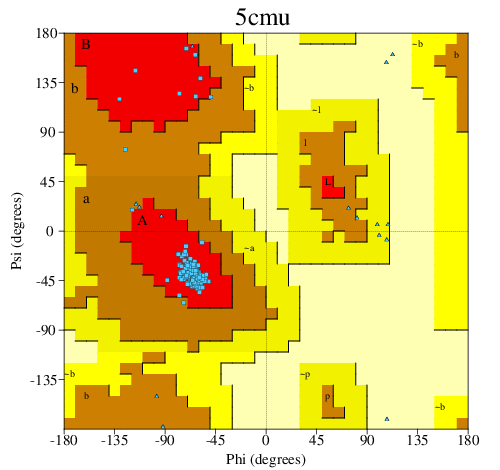
PROCHECK
|
|
|
|
|
|
Headers
|
|
|
|
References
|
|
|
|
|
|

|
|
P04578
(ENV_HV1H2) -
Envelope glycoprotein gp160 from Human immunodeficiency virus type 1 group M subtype B (isolate HXB2)
|
|
|
|
Seq:
Struc:
|
|
|
|
856 a.a.
73 a.a.*
|
|

|

|

|
|
|
|
|
|
|
|
|
|
|
Key: |
 |
PfamA domain |
|
|
 |
Secondary structure |
|
 |
CATH domain |
|
|
*
PDB and UniProt seqs differ
at 34 residue positions (black
crosses)
|
|
|
|
|
|
|
|
|
|
|
|
|
|
|
|
|
 |
|
|
|
|
|
|
| |
|
DOI no:
|
Sci Rep
5:13028
(2015)
|
|
PubMed id:
|
|
|
|
|
|
| |
|
Improved Pharmacological and Structural Properties of HIV Fusion Inhibitor AP3 over Enfuvirtide: Highlighting Advantages of Artificial Peptide Strategy.
|
|
X.Zhu,
Y.Zhu,
S.Ye,
Q.Wang,
W.Xu,
S.Su,
Z.Sun,
F.Yu,
Q.Liu,
C.Wang,
T.Zhang,
Z.Zhang,
X.Zhang,
J.Xu,
L.Du,
K.Liu,
L.Lu,
R.Zhang,
S.Jiang.
|
|
|
|
|
| |
ABSTRACT
|
|
|
|
| |
|
|
Enfuvirtide (T20), is the first HIV fusion inhibitor approved for treatment of
HIV/AIDS patients who fail to respond to the current antiretroviral drugs.
However, its clinical application is limited because of short half-life, drug
resistance and cross-reactivity with the preexisting antibodies in HIV-infected
patients. Using an artificial peptide strategy, we designed a peptide with
non-native protein sequence, AP3, which exhibited potent antiviral activity
against a broad spectrum of HIV-1 strains, including those resistant to T20, and
had remarkably longer in vivo half-life than T20. While the preexisting
antibodies in HIV-infected patients significantly suppressed T20's antiviral
activity, these antibodies neither recognized AP3, nor attenuated its anti-HIV-1
activity. Structurally different from T20, AP3 could fold into single-helix and
interact with gp41 NHR. The two residues, Met and Thr, at the N-terminus of AP3
form a hook-like structure to stabilize interaction between AP3 and NHR helices.
Therefore, AP3 has potential for further development as a new HIV fusion
inhibitor with improved antiviral efficacy, resistance profile and
pharmacological properties over enfuvirtide. Meanwhile, this study highlighted
the advantages of artificially designed peptides, and confirmed that this
strategy could be used in developing artificial peptide-based viral fusion
inhibitors against HIV and other enveloped viruses.
|
|
|
|
|
|
|
|
|
|
|
|
|
|
|
|
|
|
 |
 |
 |
|


 Links
Links



