|
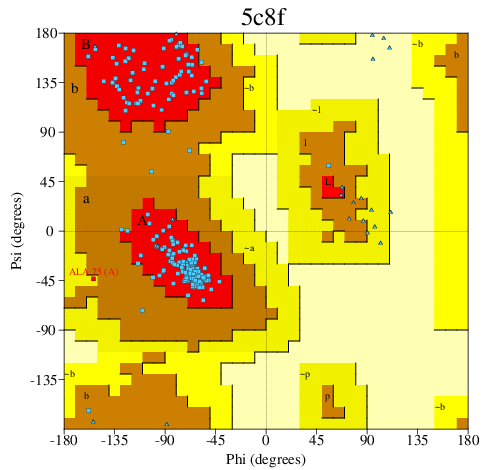
PDBsum entry 5c8f

|
|
|
|
|
|

|

|

|

|
|

|
|

|
|

|
|

|
|

|
|
|
 |

|

|
|
|
|
|
|
|
|
|
|
|
|
|
|
|
|
|
|
|
|
|
|
|
|
|
|
|
|
|
|
|
|
|
|
Transcriptional regulator
|
PDB id
|
|
|
|
5c8f
|
|
|
|
|
|
|
|
|
|
|
|
|
|
|

|

|

|
|
|
|
|
|
|
|
|
|
|
|
|
 |
|
|
|
|
|
|
| |
|
DOI no:
|
Nature
526:536-541
(2015)
|
|
PubMed id:
|
|
|
|
|
|
| |
|
Structural basis for gene regulation by a B12-dependent photoreceptor.
|
|
M.Jost,
J.Fernández-Zapata,
M.C.Polanco,
J.M.Ortiz-Guerrero,
P.Y.Chen,
G.Kang,
S.Padmanabhan,
M.Elías-Arnanz,
C.L.Drennan.
|
|
|
|
|
| |
ABSTRACT
|
|
|
|
| |
|
|
Photoreceptor proteins enable organisms to sense and respond to light. The newly
discovered CarH-type photoreceptors use a vitamin B12 derivative,
adenosylcobalamin, as the light-sensing chromophore to mediate light-dependent
gene regulation. Here we present crystal structures of Thermus thermophilus CarH
in all three relevant states: in the dark, both free and bound to operator DNA,
and after light exposure. These structures provide visualizations of how
adenosylcobalamin mediates CarH tetramer formation in the dark, how this
tetramer binds to the promoter -35 element to repress transcription, and how
light exposure leads to a large-scale conformational change that activates
transcription. In addition to the remarkable functional repurposing of
adenosylcobalamin from an enzyme cofactor to a light sensor, we find that nature
also repurposed two independent protein modules in assembling CarH. These
results expand the biological role of vitamin B12 and provide fundamental
insight into a new mode of light-dependent gene regulation.
|
|
|
|
|
|
|
|
|
|
|
|
|
|
|
|
|
|
 |
 |
 |
|


 Links
Links