 |
PDBsum entry 5ap2
|
|

|
|
PDB id:
|
|
|
|
| Name: |
|
Transferase
|
|
|
Title:
|
|
Naturally occurring mutations in the mps1 gene predispose cells to kinase inhibitor drug resistance.
|
|
Structure:
|
|
Dual specificity protein kinase ttk. Chain: a. Fragment: kinase domain, unp residues 519-808. Synonym: phosphotyrosine picked threonine-protein kinase, pyt, monopolar spindle kinase 1. Engineered: yes
|
|
Source:
|
|
Homo sapiens. Human. Organism_taxid: 9606. Expressed in: escherichia coli. Expression_system_taxid: 511693. Expression_system_variant: ai
|
|
Resolution:
|
|
|
2.80Å
|
R-factor:
|
0.197
|
R-free:
|
0.254
|
|
|
Authors:
|
|
M.D.Gurden,I.M.Westwood,A.Faisal,S.Naud,K.J.Cheung,C.Mcandrew,A.Wood, J.Schmitt,K.Boxall,G.Mak,P.Workman,R.Burke,S.Hoelder,J.Blagg, R.L.M.Van Montfort,S.Linardopoulos
|
|
Key ref:
|
|
M.D.Gurden
et al.
(2015).
Naturally Occurring Mutations in the MPS1 Gene Predispose Cells to Kinase Inhibitor Drug Resistance.
Cancer Res,
75,
3340-3354.
PubMed id:
DOI:
|
|
|
Date:
|
|
|
14-Sep-15
|
Release date:
|
23-Sep-15
|
|
|
|
|
|
|
PROCHECK
|

|
|
|
|
|
Headers
|
|
|
|
References
|
|
|
|
|
|

|
|
P33981
(TTK_HUMAN) -
Dual specificity protein kinase TTK from Homo sapiens
|
|
|
|
Seq:
Struc:
|
|
|
|
857 a.a.
256 a.a.*
|
|

|

|

|
|
|
|
|
|
|
|
|
|
|
Key: |
|
 |
Secondary structure |
|
 |
CATH domain |
|
|
*
PDB and UniProt seqs differ
at 3 residue positions (black
crosses)
|
|
|
|
|
|
|
|
|
|
|
|
|
Enzyme class:
|
|
E.C.2.7.12.1
- dual-specificity kinase.
|
|
|
|
|
|
|
Reaction:
|
|
|
1.
|
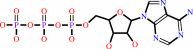
L-seryl-[protein] + ATP = O-phospho-L-seryl-[protein] + ADP + H+
|
|
2.
|
L-threonyl-[protein] + ATP = O-phospho-L-threonyl-[protein] + ADP + H+
|
|
3.
|
L-tyrosyl-[protein] + ATP = O-phospho-L-tyrosyl-[protein] + ADP + H+
|
|
|
|
|
|
|
L-seryl-[protein]
|
+
|
 ATP
ATP
|
=
|
O-phospho-L-seryl-[protein]
|
+
|
 ADP
ADP
|
+
|
H(+)
|
|
|
|
|
|
|
L-threonyl-[protein]
|
+
|
ATP
|
=
|
O-phospho-L-threonyl-[protein]
|
+
|
ADP
|
+
|
H(+)
|
|
|
|
|
|
|
L-tyrosyl-[protein]
|
+
|
ATP
|
=
|
O-phospho-L-tyrosyl-[protein]
|
+
|
ADP
|
+
|
H(+)
|
|
|
|
|
|
|
|
|
|
|
|
|
Molecule diagrams generated from .mol files obtained from the
KEGG ftp site
|
|
|
|
|
|
|
|
|
|
|
|
|
|
 |
|
|
|
|
|
|
| |
|
|
| |
|
DOI no:
|
Cancer Res
75:3340-3354
(2015)
|
|
PubMed id:
|
|
|
|
|
|
| |
|
Naturally Occurring Mutations in the MPS1 Gene Predispose Cells to Kinase Inhibitor Drug Resistance.
|
|
M.D.Gurden,
I.M.Westwood,
A.Faisal,
S.Naud,
K.M.Cheung,
C.McAndrew,
A.Wood,
J.Schmitt,
K.Boxall,
G.Mak,
P.Workman,
R.Burke,
S.Hoelder,
J.Blagg,
R.L.Van Montfort,
S.Linardopoulos.
|
|
|
|
|
| |
ABSTRACT
|
|
|
|
| |
|
|
Acquired resistance to therapy is perhaps the greatest challenge to effective
clinical management of cancer. With several inhibitors of the mitotic checkpoint
kinase MPS1 in preclinical development, we sought to investigate how resistance
against these inhibitors may arise so that mitigation or bypass strategies could
be addressed as early as possible. Toward this end, we modeled acquired
resistance to the MPS1 inhibitors AZ3146, NMS-P715, and CCT251455, identifying
five point mutations in the kinase domain of MPS1 that confer resistance against
multiple inhibitors. Structural studies showed how the MPS1 mutants conferred
resistance by causing steric hindrance to inhibitor binding. Notably, we show
that these mutations occur in nontreated cancer cell lines and primary tumor
specimens, and that they also preexist in normal lymphoblast and breast tissues.
In a parallel piece of work, we also show that the EGFR p.T790M mutation, the
most common mutation conferring resistance to the EGFR inhibitor gefitinib, also
preexists in cancer cells and normal tissue. Our results therefore suggest that
mutations conferring resistance to targeted therapy occur naturally in normal
and malignant cells and these mutations do not arise as a result of the
increased mutagenic plasticity of cancer cells. Cancer Res; 75(16); 3340-54.
©2015 AACR.
|
|
|
|
|
|
|
|
|
|
|
|
|
|
|
|
|
|
 |
 |
 |
|


 Links
Links


