 |
PDBsum entry 5fpt
 |
|
|
|
|
|
|
Enzyme class 1:
|
|
E.C.2.7.7.48
- RNA-directed Rna polymerase.
|
|
|
|
|
|
|
Reaction:
|
|
RNA(n) + a ribonucleoside 5'-triphosphate = RNA(n+1) + diphosphate
|
|
|
|
|
|
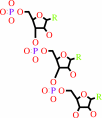 RNA(n)
|
+
|
ribonucleoside 5'-triphosphate
|
=
|
RNA(n+1)
|
+
|
 diphosphate
|
|
|
|
|
|
|
|
|
|
Enzyme class 2:
|
|
E.C.3.4.21.98
- hepacivirin.
|
|
|
|
|
|
|
Reaction:
|
|
Hydrolysis of four peptide bonds in the viral precursor polyprotein, commonly with Asp or Glu in the P6 position, Cys or Thr in P1 and Ser or Ala in P1'.
|
|
|
|
|
|
Enzyme class 3:
|
|
E.C.3.4.22.-
- ?????
|
|
|
|
|
|
|
Enzyme class 4:
|
|
E.C.3.6.1.15
- nucleoside-triphosphate phosphatase.
|
|
|
|
|
|
|
Reaction:
|
|
a ribonucleoside 5'-triphosphate + H2O = a ribonucleoside 5'-diphosphate + phosphate + H+
|
|
|
|
|
|
ribonucleoside 5'-triphosphate
|
+
|
H2O
|
=
|
ribonucleoside 5'-diphosphate
|
+
|
 phosphate
|
+
|
H(+)
|
|
|
|
|
|
|
|
|
|
Enzyme class 5:
|
|
E.C.3.6.4.13
- Rna helicase.
|
|
|
|
|
|
|
Reaction:
|
|
ATP + H2O = ADP + phosphate + H+
|
|
|
|
|
|
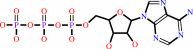 ATP
ATP
|
+
|
H2O
|
=
|
 ADP
ADP
|
+
|
phosphate
|
+
|
H(+)
|
|
|
|
|
|
|
|
|
|
|
|
|
Note, where more than one E.C. class is given (as above), each may
correspond to a different protein domain or, in the case of polyprotein
precursors, to a different mature protein.
|
|
|
|
Molecule diagrams generated from .mol files obtained from the
KEGG ftp site
|
|
|
|
|
|
|
|
|
|
|
|
|
|
 |
|
|
|
|
|
|
| |
|
|
| |
|
DOI no:
|
Proc Natl Acad Sci U S A
112:15910-15915
(2015)
|
|
PubMed id:
|
|
|
|
|
|
| |
|
Detection of secondary binding sites in proteins using fragment screening.
|
|
R.F.Ludlow,
M.L.Verdonk,
H.K.Saini,
I.J.Tickle,
H.Jhoti.
|
|
|
|
|
| |
ABSTRACT
|
|
|
|
| |
|
|
Proteins need to be tightly regulated as they control biological processes in
most normal cellular functions. The precise mechanisms of regulation are rarely
completely understood but can involve binding of endogenous ligands and/or
partner proteins at specific locations on a protein that can modulate function.
Often, these additional secondary binding sites appear separate to the primary
binding site, which, for example for an enzyme, may bind a substrate. In
previous work, we have uncovered several examples in which secondary binding
sites were discovered on proteins using fragment screening approaches. In each
case, we were able to establish that the newly identified secondary binding site
was biologically relevant as it was able to modulate function by the binding of
a small molecule. In this study, we investigate how often secondary binding
sites are located on proteins by analyzing 24 protein targets for which we have
performed a fragment screen using X-ray crystallography. Our analysis shows
that, surprisingly, the majority of proteins contain secondary binding sites
based on their ability to bind fragments. Furthermore, sequence analysis of
these previously unknown sites indicate high conservation, which suggests that
they may have a biological function, perhaps via an allosteric mechanism.
Comparing the physicochemical properties of the secondary sites with known
primary ligand binding sites also shows broad similarities indicating that many
of the secondary sites may be druggable in nature with small molecules that
could provide new opportunities to modulate potential therapeutic targets.
|
|
|
|
|
|
|
|
|
|
|
|
|
|
|
|
|
|
 |
 |
 |
|


 Links
Links


