 |
PDBsum entry 5e8r
|
|

|
|
PDB id:
|
|
|
|
| Name: |
|
Transferase
|
|
|
Title:
|
|
Human hmt1 hnrnp methyltransferase-like protein 6 (s. Cerevisiae)
|
|
Structure:
|
|
Protein arginine n-methyltransferase 6. Chain: a, b. Synonym: heterogeneous nuclear ribonucleoprotein methyltransferase- like protein 6,histone-arginine n-methyltransferase prmt6. Engineered: yes
|
|
Source:
|
|
Homo sapiens. Human. Organism_taxid: 9606. Gene: prmt6, hrmt1l6. Expressed in: spodoptera frugiperda. Expression_system_taxid: 7108.
|
|
Resolution:
|
|
|
2.55Å
|
R-factor:
|
0.221
|
R-free:
|
0.256
|
|
|
Authors:
|
|
A.Dong,H.Zeng,J.Liu,W.Tempel,A.Seitova,A.Hutchinson,C.Bountra, C.H.Arrowsmith,A.M.Edwards,J.Jin,P.J.Brown,H.Wu,Structural Genomics Consortium (Sgc)
|
|
Key ref:
|
|
M.S.Eram
et al.
(2016).
A Potent, Selective, and Cell-Active Inhibitor of Human Type I Protein Arginine Methyltransferases.
Acs Chem Biol,
11,
772-781.
PubMed id:
DOI:
|
|
|
Date:
|
|
|
14-Oct-15
|
Release date:
|
09-Dec-15
|
|
|
|
|
|
|
PROCHECK
|

|
|
|
|
|
Headers
|
|
|
|
References
|
|
|
|
|
|

|
|
Q96LA8
(ANM6_HUMAN) -
Protein arginine N-methyltransferase 6 from Homo sapiens
|
|
|
|
Seq:
Struc:
|
|
|
|
375 a.a.
332 a.a.*
|
|

|

|

|
|
|
|
|
|
|
|
|
|
|
Key: |
 |
PfamA domain |
|
|
 |
Secondary structure |
|
 |
CATH domain |
|
|
*
PDB and UniProt seqs differ
at 1 residue position (black
cross)
|
|
|
|
|
|
|
|
|
|
|
|
|
Enzyme class:
|
|
E.C.2.1.1.319
- type I protein arginine methyltransferase.
|
|
|
|
|
|
|
Reaction:
|
|
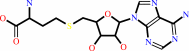
L-arginyl-[protein] + 2 S-adenosyl-L-methionine = N(omega),N(omega)- dimethyl-L-arginyl-[protein] + 2 S-adenosyl-L-homocysteine + 2 H+
|
|
|
|
|
|
L-arginyl-[protein]
|
+
|
 2
×
S-adenosyl-L-methionine
2
×
S-adenosyl-L-methionine
|
=
|
N(omega),N(omega)- dimethyl-L-arginyl-[protein]
|
+
|
 2
×
S-adenosyl-L-homocysteine
2
×
S-adenosyl-L-homocysteine
|
+
|
2
×
H(+)
Bound ligand (Het Group name = )
corresponds exactly
|
|
|
|
|
|
|
|
|
|
|
|
|
Molecule diagrams generated from .mol files obtained from the
KEGG ftp site
|
|
|
|
|
|
|
|
|
|
|
|
|
|
 |
|
|
|
|
|
|
| |
|
|
| |
|
DOI no:
|
Acs Chem Biol
11:772-781
(2016)
|
|
PubMed id:
|
|
|
|
|
|
| |
|
A Potent, Selective, and Cell-Active Inhibitor of Human Type I Protein Arginine Methyltransferases.
|
|
M.S.Eram,
Y.Shen,
M.M.Szewczyk,
H.Wu,
G.Senisterra,
F.Li,
K.V.Butler,
H.Ã.œ.Kaniskan,
B.A.Speed,
C.dela Seña,
A.Dong,
H.Zeng,
M.Schapira,
P.J.Brown,
C.H.Arrowsmith,
D.Barsyte-Lovejoy,
J.Liu,
M.Vedadi,
J.Jin.
|
|
|
|
|
| |
ABSTRACT
|
|
|
|
| |
|
|
Protein arginine methyltransferases (PRMTs) play a crucial role in a variety of
biological processes. Overexpression of PRMTs has been implicated in various
human diseases including cancer. Consequently, selective small-molecule
inhibitors of PRMTs have been pursued by both academia and the pharmaceutical
industry as chemical tools for testing biological and therapeutic hypotheses.
PRMTs are divided into three categories: type I PRMTs which catalyze mono- and
asymmetric dimethylation of arginine residues, type II PRMTs which catalyze
mono- and symmetric dimethylation of arginine residues, and type III PRMT which
catalyzes only monomethylation of arginine residues. Here, we report the
discovery of a potent, selective, and cell-active inhibitor of human type I
PRMTs, MS023, and characterization of this inhibitor in a battery of
biochemical, biophysical, and cellular assays. MS023 displayed high potency for
type I PRMTs including PRMT1, -3, -4, -6, and -8 but was completely inactive
against type II and type III PRMTs, protein lysine methyltransferases and DNA
methyltransferases. A crystal structure of PRMT6 in complex with MS023 revealed
that MS023 binds the substrate binding site. MS023 potently decreased cellular
levels of histone arginine asymmetric dimethylation. It also reduced global
levels of arginine asymmetric dimethylation and concurrently increased levels of
arginine monomethylation and symmetric dimethylation in cells. We also developed
MS094, a close analog of MS023, which was inactive in biochemical and cellular
assays, as a negative control for chemical biology studies. MS023 and MS094 are
useful chemical tools for investigating the role of type I PRMTs in health and
disease.
|
|
|
|
|
|
|
|
|
|
|
|
|
|
|
|
|
|
 |
 |
 |
|


 Links
Links


