 |
PDBsum entry 5e8n

|
|
|
|
|
|

|

|

|

|
|

|
|

|
|

|
|

|
|

|
|
|
 |

|

|
|
|
|
|
|
|
|
|
|
|
|
|
|
|
|
|
|
|
|
|
|
|
|
|
|
|
|
|
|
|
|
|
|
Immune system
|
PDB id
|
|
|
|
5e8n
|
|
|
|
|
|
|
|
|
|
|
|
|
|
|

|

|

|
|
|
|
|
|
|
|
 |
Contents |
 |
|
|
|
|
|
|
|
|
|
|
|


 272 a.a.
|
|
|
|
|
|
|
|
|
|
|


 99 a.a.
|
|
|
|
|
|
|
|
|
|
|
 258 a.a.
|
|
|
|
|
|
|
|
|
|
|
|
|
|
|
PDB id:
|
|
|
|
| Name: |
|
Immune system
|
|
|
Title:
|
|
The structure of the teipp associated trh4 peptide in complex with h- 2d(b)
|
|
Structure:
|
|
H-2 class i histocompatibility antigen, d-b alpha chain. Chain: a, d, g, j. Synonym: h-2d(b). Engineered: yes. Beta-2-microglobulin. Chain: b, e, h, k. Engineered: yes. Ceramide synthase 5. Chain: c, f, i, l.
|
|
Source:
|
|
Mus musculus. House mouse. Organism_taxid: 10090. Gene: h2-d1. Expressed in: escherichia coli. Expression_system_taxid: 562. Gene: b2m. Synthetic: yes. Organism_taxid: 10090
|
|
Resolution:
|
|
|
2.25Å
|
R-factor:
|
0.242
|
R-free:
|
0.286
|
|
|
Authors:
|
|
I.Hafstrand,E.Doorduijn,A.D.Duru,J.Buratto,C.C.Oliveira,T.Sandalova, T.Van Hall,A.Achour
|
|
Key ref:
|
|
I.Hafstrand
et al.
(2016).
The MHC Class I Cancer-Associated Neoepitope Trh4 Linked with Impaired Peptide Processing Induces a Unique Noncanonical TCR Conformer.
J Immunol,
196,
2327-2334.
PubMed id:
DOI:
|
|
|
Date:
|
|
|
14-Oct-15
|
Release date:
|
03-Feb-16
|
|
|
|
|
|
|
PROCHECK
|

|
|
|
|
|
Headers
|
|
|
|
References
|
|
|
|
|
|

|
|
P01899
(HA11_MOUSE) -
H-2 class I histocompatibility antigen, D-B alpha chain from Mus musculus
|
|
|
|
Seq:
Struc:
|
|
|
|
362 a.a.
272 a.a.
|
|

|

|

|
|
|
|
|
|
|
|
|
|
|
|
|
|
|
|
|
Enzyme class:
|
|
Chains :
E.C.2.3.1.24
- sphingosine N-acyltransferase.
|
|
|
|
|
|
|
Reaction:
|
|
a fatty acyl-CoA + sphing-4-enine = an N-acylsphing-4-enine + CoA + H+
|
|
|
|
|
|
fatty acyl-CoA
|
+
|
 sphing-4-enine
|
=
|
N-acylsphing-4-enine
|
+
|
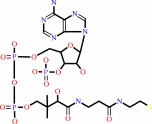 CoA
CoA
|
+
|
H(+)
|
|
|
|
|
|
|
|
|
|
|
|
|
Molecule diagrams generated from .mol files obtained from the
KEGG ftp site
|
|
|
|
|
|
|
|
|
|
|
|
|
|
 |
|
|
|
|
|
|
| |
|
|
| |
|
DOI no:
|
J Immunol
196:2327-2334
(2016)
|
|
PubMed id:
|
|
|
|
|
|
| |
|
The MHC Class I Cancer-Associated Neoepitope Trh4 Linked with Impaired Peptide Processing Induces a Unique Noncanonical TCR Conformer.
|
|
I.Hafstrand,
E.M.Doorduijn,
A.D.Duru,
J.Buratto,
C.C.Oliveira,
T.Sandalova,
T.van Hall,
A.Achour.
|
|
|
|
|
| |
ABSTRACT
|
|
|
|
| |
|
|
MHC class I downregulation represents a significant challenge for successful T
cell-based immunotherapy. T cell epitopes associated with impaired peptide
processing (TEIPP) constitute a novel category of immunogenic Ags that are
selectively presented on transporter associated with Ag processing-deficient
cells. The TEIPP neoepitopes are CD8 T cell targets, derived from nonmutated
self-proteins that might be exploited to prevent immune escape. In this study,
the crystal structure of H-2D(b) in complex with the first identified TEIPP Ag
(MCLRMTAVM) derived from the Trh4 protein has been determined to 2.25 Å
resolution. In contrast to prototypic H-2D(b) peptides, Trh4 takes a
noncanonical peptide-binding pattern with extensive sulfur-π interactions that
contribute to the overall complex stability. Importantly, the noncanonical
methionine at peptide position 5 acts as a main anchor, altering only the
conformation of the H-2D(b) residues Y156 and H155 and thereby forming a unique
MHC/peptide conformer that is essential for recognition by TEIPP-specific T
cells. Substitution of peptide residues p2C and p5M to the conservative
α-aminobutyric acid and norleucine, respectively, significantly reduced complex
stability, without altering peptide conformation or T cell recognition. In
contrast, substitution of p5M to a conventional asparagine abolished recognition
by the H-2D(b)/Trh4-specific T cell clone LnB5. We anticipate that the
H-2D(b)/Trh4 complex represents the first example, to our knowledge, of a
broader repertoire of alternative MHC class I binders.
|
|
|
|
|
|
|
|
|
|
|
|
|
|
|
|
|
|
 |
 |
 |
|
| |


 Links
Links


