 |
PDBsum entry 5ajg

|
|
|
|
|
|

|

|

|

|
|

|
|

|
|

|
|

|
|

|
|
|
 |

|

|
|
|
|
|
|
|
|
|
|
|
|
|
|
|
|
|
|
|
|
|
|
|
|
|
|
|
|
|
|
|
|
|
|
Fluorescent protein
|
PDB id
|
|
|
|
5ajg
|
|
|
|
|
|
|
|
|
|
|
|
|
|
|

|

|

|
|
|
|
|
|
|
|
|
Enzyme class:
|
|
E.C.2.7.13.3
- histidine kinase.
|
|
|
|
|
|
|
Reaction:
|
|
ATP + protein L-histidine = ADP + protein N-phospho-L-histidine
|
|
|
|
|
|
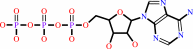 ATP
ATP
|
+
|
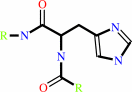 protein L-histidine
|
=
|
 ADP
ADP
|
+
|
protein N-phospho-L-histidine
|
|
|
|
|
|
|
|
|
|
|
|
|
Molecule diagrams generated from .mol files obtained from the
KEGG ftp site
|
|
|
|
|
|
|
|
|
|
|
|
|
|
 |
|
|
|
|
|
|
| |
|
|
| |
|
DOI no:
|
Biochemistry
55:4263-4274
(2016)
|
|
PubMed id:
|
|
|
|
|
|
| |
|
Structural Determinants of Improved Fluorescence in a Family of Bacteriophytochrome-Based Infrared Fluorescent Proteins: Insights from Continuum Electrostatic Calculations and Molecular Dynamics Simulations.
|
|
M.Feliks,
C.Lafaye,
X.Shu,
A.Royant,
M.Field.
|
|
|
|
|
| |
ABSTRACT
|
|
|
|
| |
|
|
Using X-ray crystallography, continuum electrostatic calculations, and molecular
dynamics simulations, we have studied the structure, protonation behavior, and
dynamics of the biliverdin chromophore and its molecular environment in a series
of genetically engineered infrared fluorescent proteins (IFPs) based on the
chromophore-binding domain of the Deinococcus radiodurans bacteriophytochrome.
Our study suggests that the experimentally observed enhancement of fluorescent
properties results from the improved rigidity and planarity of the biliverdin
chromophore, in particular of the first two pyrrole rings neighboring the
covalent linkage to the protein. We propose that the increases in the levels of
both motion and bending of the chromophore out of planarity favor the decrease
in fluorescence. The chromophore-binding pocket in some of the studied proteins,
in particular the weakly fluorescent parent protein, is shown to be readily
accessible to water molecules from the solvent. These waters entering the
chromophore region form hydrogen bond networks that affect the otherwise planar
conformation of the first three rings of the chromophore. On the basis of our
simulations, the enhancement of fluorescence in IFPs can be achieved either by
reducing the mobility of water molecules in the vicinity of the chromophore or
by limiting the interactions of the nearby protein residues with the
chromophore. Finally, simulations performed at both low and neutral pH values
highlight differences in the dynamics of the chromophore and shed light on the
mechanism of fluorescence loss at low pH.
|
|
|
|
|
|
|
|
|
|
|
|
|
|
|
|
|
|
 |
 |
 |
|


 Links
Links


