 |
PDBsum entry 4zsc
|
|

|
|
PDB id:
|
|
|
|
| Name: |
|
Isomerase
|
|
|
Title:
|
|
Human cyclophilin d complexed with an inhibitor at room temperature
|
|
Structure:
|
|
Peptidyl-prolyl cis-trans isomerase f, mitochondrial. Chain: a. Fragment: unp residues 44-207. Synonym: ppiase f,cyclophilin d,cypd,cyclophilin f,mitochondrial cyclophilin,cyp-m,rotamase f. Engineered: yes. Mutation: yes
|
|
Source:
|
|
Homo sapiens. Human. Organism_taxid: 9606. Gene: ppif, cyp3. Expressed in: escherichia coli. Expression_system_taxid: 562
|
|
Resolution:
|
|
|
1.50Å
|
R-factor:
|
0.135
|
R-free:
|
0.163
|
|
|
Authors:
|
|
M.Gelin,V.Delfosse,F.Allemand,F.Hoh,Y.Sallaz-Damaz,M.Pirocchi, W.Bourguet,J.-L.Ferrer,G.Labesse,J.-F.Guichou
|
|
Key ref:
|
|
M.Gelin
et al.
(2015).
Combining 'dry' co-crystallization and in situ diffraction to facilitate ligand screening by X-ray crystallography.
Acta Crystallogr D Biol Crystallogr,
71,
1777-1787.
PubMed id:
DOI:
|
|
|
Date:
|
|
|
13-May-15
|
Release date:
|
12-Aug-15
|
|
|
|
|
|
|
PROCHECK
|

|
|
|
|
|
Headers
|
|
|
|
References
|
|
|
|
|
|

|
|
P30405
(PPIF_HUMAN) -
Peptidyl-prolyl cis-trans isomerase F, mitochondrial from Homo sapiens
|
|
|
|
Seq:
Struc:
|
|
|
|
207 a.a.
164 a.a.*
|
|

|

|
|
|
|
|
|
|
|
|
|
|
|
Key: |
 |
PfamA domain |
|
|
 |
Secondary structure |
|
 |
CATH domain |
|
|
*
PDB and UniProt seqs differ
at 1 residue position (black
cross)
|
|
|
|
|
|
|
|
|
|
|
|
|
Enzyme class:
|
|
E.C.5.2.1.8
- peptidylprolyl isomerase.
|
|
|
|
|
|
|
Reaction:
|
|
[protein]-peptidylproline (omega=180) = [protein]-peptidylproline (omega=0)
|
|
|
|
|
|
 Peptidylproline (omega=180)
|
=
|
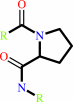 peptidylproline (omega=0)
|
|
|
|
|
|
|
|
|
|
|
|
|
Molecule diagrams generated from .mol files obtained from the
KEGG ftp site
|
|
|
|
|
|
|
|
|
|
|
|
|
|
 |
|
|
|
|
|
|
| |
|
|
| |
|
DOI no:
|
Acta Crystallogr D Biol Crystallogr
71:1777-1787
(2015)
|
|
PubMed id:
|
|
|
|
|
|
| |
|
Combining 'dry' co-crystallization and in situ diffraction to facilitate ligand screening by X-ray crystallography.
|
|
M.Gelin,
V.Delfosse,
F.Allemand,
F.Hoh,
Y.Sallaz-Damaz,
M.Pirocchi,
W.Bourguet,
J.L.Ferrer,
G.Labesse,
J.F.Guichou.
|
|
|
|
|
| |
ABSTRACT
|
|
|
|
| |
|
|
X-ray crystallography is an established technique for ligand screening in
fragment-based drug-design projects, but the required manual handling steps -
soaking crystals with ligand and the subsequent harvesting - are tedious and
limit the throughput of the process. Here, an alternative approach is reported:
crystallization plates are pre-coated with potential binders prior to protein
crystallization and X-ray diffraction is performed directly `in situ' (or
in-plate). Its performance is demonstrated on distinct and relevant therapeutic
targets currently being studied for ligand screening by X-ray crystallography
using either a bending-magnet beamline or a rotating-anode generator. The
possibility of using DMSO stock solutions of the ligands to be coated opens up a
route to screening most chemical libraries.
|
|
|
|
|
|
|
|
|
|
|
|
|
|
|
|
|
|
 |
 |
 |
|


 Links
Links


