 |
PDBsum entry 4zq9

|
|
|
|
|
|

|

|

|

|
|

|
|

|
|

|
|

|
|

|
|

|
|
|
 |

|

|
|
|
|
|
|
|
|
|
|
|
|
|
|
|
|
|
|
|
|
|
|
|
|
|
|
|
|
|
|
|
|
|
|
|
DNA binding protein/DNA
|
PDB id
|
|
|
|
4zq9
|
|
|
|
|
|
|
|
|
|
|
|
|
|
|

|

|

|
|
|
|
|
|
|
|
|
Enzyme class:
|
|
E.C.3.6.4.12
- Dna helicase.
|
|
|
|
|
|
|
Reaction:
|
|
ATP + H2O = ADP + phosphate + H+
|
|
|
|
|
|
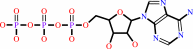 ATP
ATP
|
+
|
H2O
|
=
|
 ADP
ADP
|
+
|
 phosphate
|
+
|
H(+)
|
|
|
|
|
|
|
|
|
|
|
|
|
Molecule diagrams generated from .mol files obtained from the
KEGG ftp site
|
|
|
|
|
|
|
|
|
|
|
|
|
|
 |
|
|
|
|
|
|
| |
|
|
| |
|
DOI no:
|
J Biol Chem
290:27487-27499
(2015)
|
|
PubMed id:
|
|
|
|
|
|
| |
|
Structural Insights into the Assembly of the Adeno-associated Virus Type 2 Rep68 Protein on the Integration Site AAVS1.
|
|
F.N.Musayev,
F.Zarate-Perez,
C.Bishop,
J.W.Burgner,
C.R.Escalante.
|
|
|
|
|
| |
ABSTRACT
|
|
|
|
| |
|
|
Adeno-associated virus (AAV) is the only eukaryotic virus with the property of
establishing latency by integrating site-specifically into the human genome. The
integration site known as AAVS1 is located in chromosome 19 and contains
multiple GCTC repeats that are recognized by the AAV non-structural Rep
proteins. These proteins are multifunctional, with an N-terminal origin-binding
domain (OBD) and a helicase domain joined together by a short linker. As a first
step to understand the process of site-specific integration, we proceeded to
characterize the recognition and assembly of Rep68 onto the AAVS1 site. We first
determined the x-ray structure of AAV-2 Rep68 OBD in complex with the AAVS1 DNA
site. Specificity is achieved through the interaction of a glycine-rich loop
that binds the major groove and an α-helix that interacts with a downstream
minor groove on the same face of the DNA. Although the structure shows a complex
with three OBD molecules bound to the AAVS1 site, we show by using analytical
centrifugation and electron microscopy that the full-length Rep68 forms a
heptameric complex. Moreover, we determined that a minimum of two direct repeats
is required to form a stable complex and to melt DNA. Finally, we show that
although the individual domains bind DNA poorly, complex assembly requires
oligomerization and cooperation between its OBD, helicase, and the linker
domains.
|
|
|
|
|
|
|
|
|
|
|
|
|
|
|
|
|
|
 |
 |
 |
|


 Links
Links


