 |
PDBsum entry 4zpq

|
|
|
|
|
|

|

|

|

|
|

|
|

|
|

|
|

|
|

|
|

|
|

|
|
|
 |

|

|
|
|
|
|
|
|
|
|
|
|
|
|
|
|
|
|
|
|
|
|
|
|
|
|
|
|
|
|
|
|
|
|
|
|
|
Cell adhesion
|
PDB id
|
|
|
|
4zpq
|
|
|
|
|
|
|
|
|
|
|
|
|
|
|

|

|

|
|
|
|
|
|
|
PDB id:
|
|
|
|
| Name: |
|
Cell adhesion
|
|
|
Title:
|
|
Crystal structure of protocadherin gamma c5 ec1-3
|
|
Structure:
|
|
Mcg133388, isoform cra_f. Chain: a, b, c. Fragment: unp residues 30-345. Synonym: pcdhgc5 protein,protein pcdhgc5,protocadherin gamma c-v, protocadherin gamma c5,protocadherin gamma subfamily c,5. Engineered: yes
|
|
Source:
|
|
Mus musculus. Mouse. Organism_taxid: 10090. Gene: pcdhgc5, mcg_133388. Expressed in: homo sapiens. Expression_system_taxid: 9606. Expression_system_cell_line: hek293
|
|
Resolution:
|
|
|
3.10Å
|
R-factor:
|
0.217
|
R-free:
|
0.252
|
|
|
Authors:
|
|
H.N.Wolcott,K.M.Goodman,F.Bahna,S.Mannepalli,L.Shapiro
|
|
Key ref:
|
|
R.Rubinstein
et al.
(2015).
Molecular logic of neuronal self-recognition through protocadherin domain interactions.
Cell,
163,
629-642.
PubMed id:
DOI:
|
|
|
Date:
|
|
|
08-May-15
|
Release date:
|
28-Oct-15
|
|
|
|
|
|
|
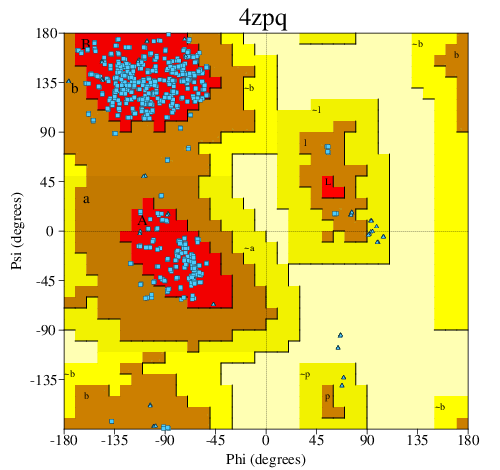
PROCHECK
|
|
|
|
|
|
Headers
|
|
|
|
References
|
|
|
|
|
|

|
|
Q91XW9
(Q91XW9_MOUSE) -
Pcdhgc5 protein from Mus musculus
|
|
|
|
Seq:
Struc:
|
|
|
|
944 a.a.
315 a.a.
|
|

|

|

|
|
|
|
|
|
|
|
|
|
|
Key: |
 |
PfamA domain |
|
|
 |
Secondary structure |
|
|
|
|
|
|
|
|
|
|
|
|
|
|
|
|
|
 |
|
|
|
|
|
|
| |
|
DOI no:
|
Cell
163:629-642
(2015)
|
|
PubMed id:
|
|
|
|
|
|
| |
|
Molecular logic of neuronal self-recognition through protocadherin domain interactions.
|
|
R.Rubinstein,
C.A.Thu,
K.M.Goodman,
H.N.Wolcott,
F.Bahna,
S.Mannepalli,
G.Ahlsen,
M.Chevee,
A.Halim,
H.Clausen,
T.Maniatis,
L.Shapiro,
B.Honig.
|
|
|
|
|
| |
ABSTRACT
|
|
|
|
| |
|
|
Self-avoidance, a process preventing interactions of axons and dendrites from
the same neuron during development, is mediated in vertebrates through the
stochastic single-neuron expression of clustered protocadherin protein isoforms.
Extracellular cadherin (EC) domains mediate isoform-specific homophilic binding
between cells, conferring cell recognition through a poorly understood
mechanism. Here, we report crystal structures for the EC1-EC3 domain regions
from four protocadherin isoforms representing the α, β, and γ subfamilies.
All are rod shaped and monomeric in solution. Biophysical measurements, cell
aggregation assays, and computational docking reveal that trans binding between
cells depends on the EC1-EC4 domains, which interact in an antiparallel
orientation. We also show that the EC6 domains are required for the formation of
cis-dimers. Overall, our results are consistent with a model in which
protocadherin cis-dimers engage in a head-to-tail interaction between EC1-EC4
domains from apposed cell surfaces, possibly forming a zipper-like protein
assembly, and thus providing a size-dependent self-recognition mechanism.
|
|
|
|
|
|
|
|
|
|
|
|
|
|
|
|
|
|
 |
 |
 |
|


 Links
Links


