 |
PDBsum entry 4zpg

|
|
|
|
|
|

|

|

|

|
|

|
|

|
|

|
|

|
|

|
|
|
 |

|

|
|
|
|
|
|
|
|
|
|
|
|
|
|
|
|
|
|
|
|
|
|
|
|
|
|
|
|
|
|
|
|
|
|
Hydrolase/hydrolase inhibitor
|
PDB id
|
|
|
|
4zpg
|
|
|
|
|
|
|
|
|
|
|
|
|
|
|

|

|

|
|
|
|
|
|
|
PDB id:
|
|
|
|
| Name: |
|
Hydrolase/hydrolase inhibitor
|
|
|
Title:
|
|
Bace1 in complex with 8-benzyl-4-(cyclohexylamino)-1-(3-fluorophenyl)- 7-methyl-1,3,8-triazaspiro[4.5]dec-3-en-2-one
|
|
Structure:
|
|
Beta-secretase 1. Chain: a. Synonym: aspartyl protease 2,asp 2,beta-site amyloid precursor protein cleaving enzyme 1,beta-site app cleaving enzyme 1,memapsin-2, membrane-associated aspartic protease 2. Engineered: yes
|
|
Source:
|
|
Homo sapiens. Human. Organism_taxid: 9606. Gene: bace1, bace, kiaa1149. Expressed in: escherichia coli. Expression_system_taxid: 562
|
|
Resolution:
|
|
|
2.00Å
|
R-factor:
|
0.170
|
R-free:
|
0.188
|
|
|
Authors:
|
|
P.Orth
|
|
Key ref:
|
|
M.Egbertson
et al.
(2015).
Methyl-substitution of an iminohydantoin spiropiperidine β-secretase (BACE-1) inhibitor has a profound effect on its potency.
Bioorg Med Chem Lett,
25,
4812-4819.
PubMed id:
DOI:
|
|
|
Date:
|
|
|
07-May-15
|
Release date:
|
05-Aug-15
|
|
|
|
|
|
|
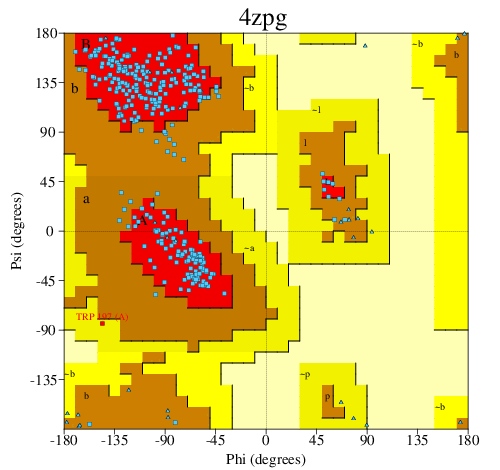
PROCHECK
|
|
|
|
|
|
Headers
|
|
|
|
References
|
|
|
|
|
|

|
|
P56817
(BACE1_HUMAN) -
Beta-secretase 1 from Homo sapiens
|
|
|
|
Seq:
Struc:
|
|
|
|
501 a.a.
369 a.a.*
|
|

|

|

|
|
|
|
|
|
|
|
|
|
|
Key: |
 |
PfamA domain |
|
|
 |
Secondary structure |
|
 |
CATH domain |
|
|
*
PDB and UniProt seqs differ
at 2 residue positions (black
crosses)
|
|
|
|
|
|
|
|
|
|
|
|
|
|
|
|
|
 |
|
|
|
|
|
|
| |
|
DOI no:
|
Bioorg Med Chem Lett
25:4812-4819
(2015)
|
|
PubMed id:
|
|
|
|
|
|
| |
|
Methyl-substitution of an iminohydantoin spiropiperidine β-secretase (BACE-1) inhibitor has a profound effect on its potency.
|
|
M.Egbertson,
G.B.McGaughey,
S.M.Pitzenberger,
S.R.Stauffer,
C.A.Coburn,
S.J.Stachel,
W.Yang,
J.C.Barrow,
L.A.Neilson,
M.McWherter,
D.Perlow,
B.Fahr,
S.Munshi,
T.J.Allison,
K.Holloway,
H.G.Selnick,
Z.Yang,
J.Swestock,
A.J.Simon,
S.Sankaranarayanan,
D.Colussi,
K.Tugusheva,
M.T.Lai,
B.Pietrak,
S.Haugabook,
L.Jin,
I.W.Chen,
M.Holahan,
M.Stranieri-Michener,
J.J.Cook,
J.Vacca,
S.L.Graham.
|
|
|
|
|
| |
ABSTRACT
|
|
|
|
| |
|
|
The IC50 of a beta-secretase (BACE-1) lead compound was improved ∼200-fold
from 11μM to 55nM through the addition of a single methyl group. Computational
chemistry, small molecule NMR, and protein crystallography capabilities were
used to compare the solution conformation of the ligand under varying pH
conditions to its conformation when bound in the active site. Chemical
modification then explored available binding pockets adjacent to the ligand. A
strategically placed methyl group not only maintained the required pKa of the
piperidine nitrogen and filled a small hydrophobic pocket, but more importantly,
stabilized the conformation best suited for optimized binding to the receptor.
|
|
|
|
|
|
|
|
|
|
|
|
|
|
|
|
|
|
 |
 |
 |
|


 Links
Links


