 |
PDBsum entry 4zp6
 |
|
|
|
|
|
|
Enzyme class 2:
|
|
E.C.2.7.7.48
- RNA-directed Rna polymerase.
|
|
|
|
|
|
|
Reaction:
|
|
RNA(n) + a ribonucleoside 5'-triphosphate = RNA(n+1) + diphosphate
|
|
|
|
|
|
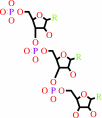 RNA(n)
|
+
|
ribonucleoside 5'-triphosphate
|
=
|
RNA(n+1)
|
+
|
 diphosphate
|
|
|
|
|
|
|
|
|
|
Enzyme class 3:
|
|
E.C.3.4.22.28
- picornain 3C.
|
|
|
|
|
|
|
Reaction:
|
|
Selective cleavage of Gln-|-Gly bond in the poliovirus polyprotein. In other picornavirus reactions Glu may be substituted for Gln, and Ser or Thr for Gly.
|
|
|
|
|
|
Enzyme class 4:
|
|
E.C.3.4.22.29
- picornain 2A.
|
|
|
|
|
|
|
Reaction:
|
|
Selective cleavage of Tyr-|-Gly bond in the picornavirus polyprotein. In other picornavirus reactions Glu may be substituted for Gln, and Ser or Thr for Gly.
|
|
|
|
|
|
Enzyme class 5:
|
|
E.C.3.6.1.15
- nucleoside-triphosphate phosphatase.
|
|
|
|
|
|
|
Reaction:
|
|
a ribonucleoside 5'-triphosphate + H2O = a ribonucleoside 5'-diphosphate + phosphate + H+
|
|
|
|
|
|
ribonucleoside 5'-triphosphate
|
+
|
H2O
|
=
|
ribonucleoside 5'-diphosphate
|
+
|
 phosphate
|
+
|
H(+)
|
|
|
|
|
|
|
|
|
|
|
|
|
Note, where more than one E.C. class is given (as above), each may
correspond to a different protein domain or, in the case of polyprotein
precursors, to a different mature protein.
|
|
|
|
Molecule diagrams generated from .mol files obtained from the
KEGG ftp site
|
|
|
|
|
|
|
|
|
|
|
|
|
|
 |
|
|
|
|
|
|
| |
|
|
| |
|
DOI no:
|
J Biol Chem
291:13999-14011
(2016)
|
|
PubMed id:
|
|
|
|
|
|
| |
|
Design of a Genetically Stable High Fidelity Coxsackievirus B3 Polymerase That Attenuates Virus Growth in Vivo.
|
|
S.McDonald,
A.Block,
S.Beaucourt,
G.Moratorio,
M.Vignuzzi,
O.B.Peersen.
|
|
|
|
|
| |
ABSTRACT
|
|
|
|
| |
|
|
Positive strand RNA viruses replicate via a virally encoded RNA-dependent RNA
polymerase (RdRP) that uses a unique palm domain active site closure mechanism
to establish the canonical two-metal geometry needed for catalysis. This
mechanism allows these viruses to evolutionarily fine-tune their replication
fidelity to create an appropriate distribution of genetic variants known as a
quasispecies. Prior work has shown that mutations in conserved motif A
drastically alter RdRP fidelity, which can be either increased or decreased
depending on the viral polymerase background. In the work presented here, we
extend these studies to motif D, a region that forms the outer edge of the NTP
entry channel where it may act as a nucleotide sensor to trigger active site
closure. Crystallography, stopped-flow kinetics, quench-flow reactions, and
infectious virus studies were used to characterize 15 engineered mutations in
coxsackievirus B3 polymerase. Mutations that interfere with the transport of the
metal A Mg(2+) ion into the active site had only minor effects on RdRP function,
but the stacking interaction between Phe(364) and Pro(357), which is absolutely
conserved in enteroviral polymerases, was found to be critical for processive
elongation and virus growth. Mutating Phe(364) to tryptophan resulted in a
genetically stable high fidelity virus variant with significantly reduced
pathogenesis in mice. The data further illustrate the importance of the palm
domain movement for RdRP active site closure and demonstrate that protein
engineering can be used to alter viral polymerase function and attenuate virus
growth and pathogenesis.
|
|
|
|
|
|
|
|
|
|
|
|
|
|
|
|
|
|
 |
 |
 |
|


 Links
Links


