|
PDBsum entry 4zk8

|
|
|
|
|
|

|

|

|

|
|

|
|

|
|

|
|

|
|

|
|
|
 |

|

|
|
|
|
|
|
|
|
|
|
|
|
|
|
|
|
|
|
|
|
|
|
|
|
|
|
|
|
|
|
|
|
|
|
Oxidoreductase
|
PDB id
|
|
|
|
4zk8
|
|
|
|
|
|
|
|
|
|
|
|
|
|
|

|

|

|
|
|
|
|
|
|
|
|
Enzyme class:
|
|
E.C.1.7.2.1
- nitrite reductase (NO-forming).
|
|
|
|
|
|
|
Reaction:
|
|
nitric oxide + Fe(III)-[cytochrome c] + H2O = Fe(II)-[cytochrome c] + nitrite + 2 H+
|
|
|
|
|
|
 nitric oxide
|
+
|
Fe(III)-[cytochrome c]
|
+
|
H2O
|
=
|
Fe(II)-[cytochrome c]
|
+
|
 nitrite
|
+
|
2
×
H(+)
|
|
|
|
|
|
|
|
|
|
Cofactor:
|
|
Cu cation or Fe cation; FAD
|
|
|
|
|
|
Cu cation
|
or
|
Fe cation
|
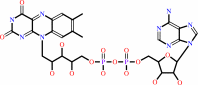 FAD
FAD
|
|
|
|
|
|
|
Molecule diagrams generated from .mol files obtained from the
KEGG ftp site
|
|
|
|
|
|
|
|
|
|
|
|
|
|
 |
|
|
|
|
|
|
| |
|
|
| |
|
DOI no:
|
J Biochem (tokyo)
155:123-135
(2014)
|
|
PubMed id:
|
|
|
|
|
|
| |
|
Structural insights into the function of a thermostable copper-containing nitrite reductase.
|
|
Y.Fukuda,
K.M.Tse,
M.Lintuluoto,
Y.Fukunishi,
E.Mizohata,
H.Matsumura,
H.Takami,
M.Nojiri,
T.Inoue.
|
|
|
|
|
| |
ABSTRACT
|
|
|
|
| |
|
|
Copper-containing nitrite reductase (CuNIR) catalyzes the reduction of nitrite
(NO(-)2) to nitric oxide (NO) during denitrification. We determined the crystal
structures of CuNIR from thermophilic gram-positive bacterium, Geobacillus
thermodenitrificans (GtNIR) in chloride- and formate-bound forms of wild type at
1.15 Å resolution and the nitrite-bound form of the C135A mutant at 1.90 Å
resolution. The structure of C135A with nitrite displays a unique η(1)-O
coordination mode of nitrite at the catalytic copper site (T2Cu), which has
never been observed at the T2Cu site in known wild-type CuNIRs, because the
mobility of two residues essential to catalytic activity, Asp98 and His244, are
sterically restricted in GtNIR by Phe109 on a characteristic loop structure that
is found above Asp98 and by an unusually short CH-O hydrogen bond observed
between His244 and water, respectively. A detailed comparison of the WT
structure with the nitrite-bound C135A structure implies the replacement of
hydrogen-bond networks around His244 and predicts the flow path of protons
consumed by nitrite reduction. On the basis of these observations, the reaction
mechanism of GtNIR through the η(1)-O coordination manner is proposed.
|
|
|
|
|
|
|
|
|
|
|
|
|
|
|
|
|
|
 |
 |
 |
|


 Links
Links