 |
PDBsum entry 4zj2
|
|

|
|
PDB id:
|
|
|
|
| Name: |
|
Hydrolase
|
|
|
Title:
|
|
Crystal structure of p-acrylamido-phenylalanine modified tem1 beta- lactamase from escherichia coli :e166n mutant
|
|
Structure:
|
|
Beta-lactamase tem. Chain: a. Synonym: irt-4,penicillinase,tem-1,tem-16/caz-7,tem-2,tem-24/caz-6, tem-3,tem-4,tem-5,tem-6,tem-8/caz-2. Engineered: yes. Mutation: yes
|
|
Source:
|
|
Escherichia coli. Organism_taxid: 562. Gene: bla, blat-3, blat-4, blat-5, blat-6. Expressed in: escherichia coli. Expression_system_taxid: 562
|
|
Resolution:
|
|
|
1.80Å
|
R-factor:
|
0.168
|
R-free:
|
0.209
|
|
|
Authors:
|
|
H.Xiao,F.Nasertorabi,S.Choi,G.W.Han,S.A.Reed,C.S.Stevens,P.G.Schultz
|
|
Key ref:
|
|
H.Xiao
et al.
(2015).
Exploring the potential impact of an expanded genetic code on protein function.
Proc Natl Acad Sci U S A,
112,
6961-6966.
PubMed id:
DOI:
|
|
|
Date:
|
|
|
28-Apr-15
|
Release date:
|
20-May-15
|
|
|
|
|
|
|
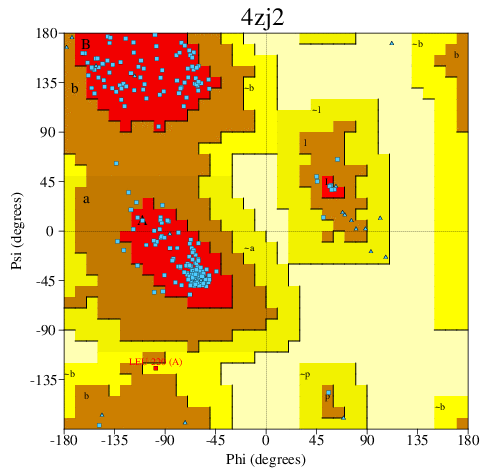
PROCHECK
|
|
|
|
|
|
Headers
|
|
|
|
References
|
|
|
|
|
|

|
|
P62593
(BLAT_ECOLX) -
Beta-lactamase TEM from Escherichia coli
|
|
|
|
Seq:
Struc:
|
|
|
|
286 a.a.
265 a.a.*
|
|

|

|

|
|
|
|
|
|
|
|
|
|
|
Key: |
 |
PfamA domain |
|
|
 |
Secondary structure |
|
 |
CATH domain |
|
|
*
PDB and UniProt seqs differ
at 4 residue positions (black
crosses)
|
|
|
|
|
|
|
|
|
|
|
|
|
|
|
|
|
 |
|
|
|
|
|
|
| |
|
DOI no:
|
Proc Natl Acad Sci U S A
112:6961-6966
(2015)
|
|
PubMed id:
|
|
|
|
|
|
| |
|
Exploring the potential impact of an expanded genetic code on protein function.
|
|
H.Xiao,
F.Nasertorabi,
S.H.Choi,
G.W.Han,
S.A.Reed,
R.C.Stevens,
P.G.Schultz.
|
|
|
|
|
| |
ABSTRACT
|
|
|
|
| |
|
|
With few exceptions, all living organisms encode the same 20 canonical amino
acids; however, it remains an open question whether organisms with additional
amino acids beyond the common 20 might have an evolutionary advantage. Here, we
begin to test that notion by making a large library of mutant enzymes in which
10 structurally distinct noncanonical amino acids were substituted at single
sites randomly throughout TEM-1 β-lactamase. A screen for growth on the
β-lactam antibiotic cephalexin afforded a unique p-acrylamido-phenylalanine
(AcrF) mutation at Val-216 that leads to an increase in catalytic efficiency by
increasing kcat, but not significantly affecting KM. To understand the
structural basis for this enhanced activity, we solved the X-ray crystal
structures of the ligand-free mutant enzyme and of the deacylation-defective
wild-type and mutant cephalexin acyl-enzyme intermediates. These structures show
that the Val-216-AcrF mutation leads to conformational changes in key active
site residues-both in the free enzyme and upon formation of the acyl-enzyme
intermediate-that lower the free energy of activation of the substrate
transacylation reaction. The functional changes induced by this mutation could
not be reproduced by substitution of any of the 20 canonical amino acids for
Val-216, indicating that an expanded genetic code may offer novel solutions to
proteins as they evolve new activities.
|
|
|
|
|
|
|
|
|
|
|
|
|
|
|
|
|
|
 |
 |
 |
|


 Links
Links


