 |
PDBsum entry 4zj0

|
|
|
|
|
|

|

|

|

|
|

|
|

|
|

|
|

|
|

|
|
|
 |

|

|
|
|
|
|
|
|
|
|
|
|
|
|
|
|
|
|
|
|
|
|
|
|
|
|
|
|
|
|
|
|
|
|
|
Transport protein
|
PDB id
|
|
|
|
4zj0
|
|
|
|
|
|
|
|
|
|
|
|
|
|
|

|

|

|
|
|
|
|
|
|
PDB id:
|
|
|
|
| Name: |
|
Transport protein
|
|
|
Title:
|
|
The crystal structure of monomer q108k:k40l:y60w crbpii bound to all- trans-retinal
|
|
Structure:
|
|
Retinol-binding protein 2. Chain: a, b. Fragment: unp residues 2-134. Synonym: cellular retinol-binding protein ii,crbp-ii. Engineered: yes. Mutation: yes
|
|
Source:
|
|
Homo sapiens. Human. Organism_taxid: 9606. Gene: rbp2, crbp2. Expressed in: escherichia coli. Expression_system_taxid: 562.
|
|
Resolution:
|
|
|
1.50Å
|
R-factor:
|
0.201
|
R-free:
|
0.251
|
|
|
Authors:
|
|
Z.Nossoni,Z.Assar,W.Wang,C.Vasileiou,B.Borhan,J.H.Geiger
|
|
Key ref:
|
|
Z.Assar
et al.
(2016).
Domain-Swapped Dimers of Intracellular Lipid-Binding Proteins: Evidence for Ordered Folding Intermediates.
Structure,
24,
1590-1598.
PubMed id:
|
|
|
Date:
|
|
|
28-Apr-15
|
Release date:
|
11-May-16
|
|
|
|
|
|
|
PROCHECK
|

|
|
|
|
|
Headers
|
|
|
|
References
|
|
|
|
|
|

|
|
P50120
(RET2_HUMAN) -
Retinol-binding protein 2 from Homo sapiens
|
|
|
|
Seq:
Struc:
|
|
|
|
134 a.a.
133 a.a.*
|
|

|
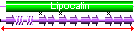
|
|
|
|
|
|
|
|
|
|
|
|
Key: |
 |
PfamA domain |
|
|
 |
Secondary structure |
|
 |
CATH domain |
|
|
*
PDB and UniProt seqs differ
at 3 residue positions (black
crosses)
|
|
|
|
|
|
|
|
|
|
|
|
|
|
|
|
|
 |
|
|
|
|
|
|
| |
|
|
Structure
24:1590-1598
(2016)
|
|
PubMed id:
|
|
|
|
|
|
| |
|
Domain-Swapped Dimers of Intracellular Lipid-Binding Proteins: Evidence for Ordered Folding Intermediates.
|
|
Z.Assar,
Z.Nossoni,
W.Wang,
E.M.Santos,
K.Kramer,
C.McCornack,
C.Vasileiou,
B.Borhan,
J.H.Geiger.
|
|
|
|
|
| |
ABSTRACT
|
|
|
|
| |
|
|
Human Cellular Retinol Binding Protein II (hCRBPII), a member of the
intracellular lipid-binding protein family, is a monomeric protein responsible
for the intracellular transport of retinol and retinal. Herein we report that
hCRBPII forms an extensive domain-swapped dimer during bacterial expression. The
domain-swapped region encompasses almost half of the protein. The dimer
represents a novel structural architecture with the mouths of the two binding
cavities facing each other, producing a new binding cavity that spans the length
of the protein complex. Although wild-type hCRBPII forms the dimer, the
propensity for dimerization can be substantially increased via mutation at
Tyr60. The monomeric form of the wild-type protein represents the
thermodynamically more stable species, making the domain-swapped dimer a
kinetically trapped entity. Hypothetically, the wild-type protein has evolved to
minimize dimerization of the folding intermediate through a critical hydrogen
bond (Tyr60-Glu72) that disfavors the dimeric form.
|
|
|
|
|
|
|
|
|
|
|
|
|
|
|
|
|
|
 |
 |
 |
|


 Links
Links


