 |
PDBsum entry 4z6z

|
|
|
|
|
|

|

|

|

|
|

|
|

|
|

|
|

|
|

|
|

|
|
|
 |

|

|
|
|
|
|
|
|
|
|
|
|
|
|
|
|
|
|
|
|
|
|
|
|
|
|
|
|
|
|
|
|
|
|
|
|
Oxidoreductase
|
PDB id
|
|
|
|
4z6z
|
|
|
|
|
|
|
|
|
|
|
|
|
|
|

|

|

|
|
|
|
|
|
|
PDB id:
|
|
|
|
| Name: |
|
Oxidoreductase
|
|
|
Title:
|
|
Structure of homoprotocatechuate 2,3-dioxygenase from b.Fuscum in complex with 4-sulfonyl catechol at 1.52 ang resolution
|
|
Structure:
|
|
Homoprotocatechuate 2,3-dioxygenase. Chain: a, b, c, d. Engineered: yes
|
|
Source:
|
|
Brevibacterium fuscum. Organism_taxid: 47914. Atcc: 15993. Expressed in: escherichia coli. Expression_system_taxid: 562.
|
|
Resolution:
|
|
|
1.52Å
|
R-factor:
|
0.123
|
R-free:
|
0.161
|
|
|
Authors:
|
|
E.G.Kovaleva,J.D.Lipscomb
|
|
Key ref:
|
|
E.G.Kovaleva
et al.
(2015).
Structural Basis for Substrate and Oxygen Activation in Homoprotocatechuate 2,3-Dioxygenase: Roles of Conserved Active Site Histidine 200.
Biochemistry,
54,
5329-5339.
PubMed id:
DOI:
|
|
|
Date:
|
|
|
06-Apr-15
|
Release date:
|
26-Aug-15
|
|
|
|
|
|
|
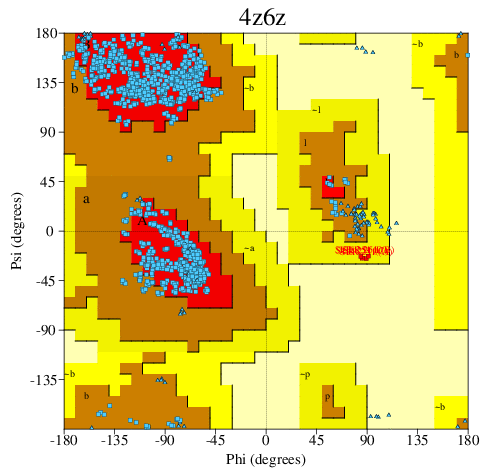
PROCHECK
|
|
|
|
|
|
Headers
|
|
|
|
References
|
|
|
|
|
|

|
|
Q45135
(Q45135_9MICO) -
Homoprotocatechuate 2,3-dioxygenase from Brevibacterium fuscum
|
|
|
|
Seq:
Struc:
|
|
|
|
365 a.a.
355 a.a.
|
|

|

|

|
|
|
|
|
|
|
|
|
|
|
Key: |
 |
PfamA domain |
|
|
 |
Secondary structure |
|
 |
CATH domain |
|
|
|
|
|
|
|
|
|
|
|
|
|
|
|
|
|
 |
|
|
|
|
|
|
| |
|
DOI no:
|
Biochemistry
54:5329-5339
(2015)
|
|
PubMed id:
|
|
|
|
|
|
| |
|
Structural Basis for Substrate and Oxygen Activation in Homoprotocatechuate 2,3-Dioxygenase: Roles of Conserved Active Site Histidine 200.
|
|
E.G.Kovaleva,
M.S.Rogers,
J.D.Lipscomb.
|
|
|
|
|
| |
ABSTRACT
|
|
|
|
| |
|
|
Kinetic and spectroscopic studies have shown that the conserved active site
residue His200 of the extradiol ring-cleaving homoprotocatechuate
2,3-dioxygenase (FeHPCD) from Brevibacterium fuscum is critical for efficient
catalysis. The roles played by this residue are probed here by analysis of the
steady-state kinetics, pH dependence, and X-ray crystal structures of the FeHPCD
position 200 variants His200Asn, His200Gln, and His200Glu alone and in complex
with three catecholic substrates (homoprotocatechuate, 4-sulfonylcatechol, and
4-nitrocatechol) possessing substituents with different inductive capacity.
Structures determined at 1.35-1.75 Å resolution show that there is essentially
no change in overall active site architecture or substrate binding mode for
these variants when compared to the structures of the wild-type enzyme and its
analogous complexes. This shows that the maximal 50-fold decrease in kcat for
ring cleavage, the dramatic changes in pH dependence, and the switch from ring
cleavage to ring oxidation of 4-nitrocatechol by the FeHPCD variants can be
attributed specifically to the properties of the altered second-sphere residue
and the substrate. The results suggest that proton transfer is necessary for
catalysis, and that it occurs most efficiently when the substrate provides the
proton and His200 serves as a catalyst. However, in the absence of an available
substrate proton, a defined proton-transfer pathway in the protein can be
utilized. Changes in the steric bulk and charge of the residue at position 200
appear to be capable of altering the rate-limiting step in catalysis and,
perhaps, the nature of the reactive species.
|
|
|
|
|
|
|
|
|
|
|
|
|
|
|
|
|
|
 |
 |
 |
|


 Links
Links


