 |
PDBsum entry 4xr8

|
|
|
|
|
|

|

|

|

|
|

|
|

|
|

|
|

|
|

|
|

|
|
|
 |

|

|
|
|
|
|
|
|
|
|
|
|
|
|
|
|
|
|
|
|
|
|
|
|
|
|
|
|
|
|
|
|
|
|
|
|
Viral protein/ antitumor protein
|
PDB id
|
|
|
|
4xr8
|
|
|
|
|
|
|
|
|
|
|
|
|
|
|

|

|

|
|
|
|
|
|
|
|
 |
Contents |
 |
|
|
|
|
|
|
|
|
|
|
|

 383 a.a.
|
|
|
|
|
|
|
|
|
|
|

 199 a.a.
|
|
|
|
|
|
|
|
|
|
|
 143 a.a.
|
|
|
|
|
|
|
|
|
|
|
 151 a.a.
|
|
|
|
|
|
|
|
|
|
|
|
|
|
|
|
|
PDB id:
|
|
|
|
| Name: |
|
Viral protein/ antitumor protein
|
|
|
Title:
|
|
Crystal structure of the hpv16 e6/e6ap/p53 ternary complex at 2.25 a resolution
|
|
Structure:
|
|
Maltose-binding periplasmic protein, ubiquitin ligase e6ap. Chain: a, b. Synonym: mbp,mmbp,maltodextrin-binding protein,mbp,mmbp,maltodextrin- binding protein. Engineered: yes. Mutation: yes. Cellular tumor antigen p53. Chain: c, d. Synonym: antigen ny-co-13,phosphoprotein p53,tumor suppressor p53.
|
|
Source:
|
|
Escherichia coli, homo sapiens. Human. Organism_taxid: 83333, 9606. Strain: k12. Gene: male, b4034, jw3994. Expressed in: escherichia coli k-12. Expression_system_taxid: 83333. Homo sapiens. Organism_taxid: 9606.
|
|
Resolution:
|
|
|
2.25Å
|
R-factor:
|
0.196
|
R-free:
|
0.246
|
|
|
Authors:
|
|
D.Martinez-Zapien,F.X.Ruiz,A.Mitschler,A.Podjarny,G.Trave,K.Zanier
|
|
Key ref:
|
|
D.Martinez-Zapien
et al.
(2016).
Structure of the E6/E6AP/p53 complex required for HPV-mediated degradation of p53.
Nature,
529,
541-545.
PubMed id:
DOI:
|
|
|
Date:
|
|
|
20-Jan-15
|
Release date:
|
03-Feb-16
|
|
|
|
|
|
|
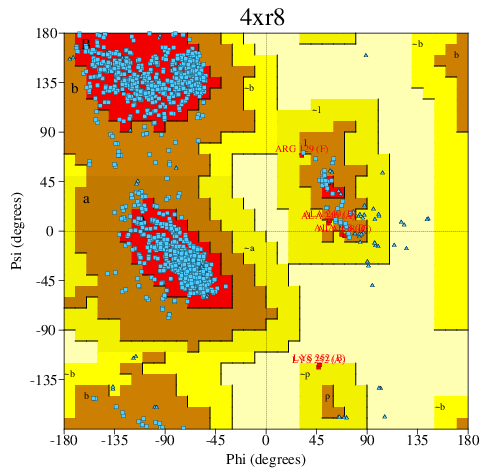
PROCHECK
|
|
|
|
|
|
Headers
|
|
|
|
References
|
|
|
|
|
|

|
|
P0AEX9
(MALE_ECOLI) -
Maltose/maltodextrin-binding periplasmic protein from Escherichia coli (strain K12)
|
|
|
|
Seq:
Struc:
|
|
|
|
396 a.a.
383 a.a.*
|
|

|

|

|
|
|
|
|
|
|
|
|
|
|
|
|
|
Q05086
(UBE3A_HUMAN) -
Ubiquitin-protein ligase E3A from Homo sapiens
|
|
|
|
Seq:
Struc:
|
|
|
|
875 a.a.
383 a.a.*
|
|
|

|

|
|
|
|
|
|
|
|
|
|
|
|

|
|
P04637
(P53_HUMAN) -
Cellular tumor antigen p53 from Homo sapiens
|
|
|
|
Seq:
Struc:
|
|
|
|
393 a.a.
199 a.a.
|
|
|

|

|
|
|
|
|
|
|
|
|
|
|
|
|
|
|
|
|
Enzyme class 2:
|
|
Chains A, B, C, D, F, H:
E.C.?
|
|
|
|
|
|
|
Enzyme class 3:
|
|
Chains A, B:
E.C.2.3.2.26
- HECT-type E3 ubiquitin transferase.
|
|
|
|
|
|
|
Reaction:
|
|
S-ubiquitinyl-[E2 ubiquitin-conjugating enzyme]-L-cysteine + [acceptor protein]-L-lysine = [E2 ubiquitin-conjugating enzyme]-L-cysteine + N6- ubiquitinyl-[acceptor protein]-L-lysine
|
|
|
|
|
|
|
|
|
Note, where more than one E.C. class is given (as above), each may
correspond to a different protein domain or, in the case of polyprotein
precursors, to a different mature protein.
|
|
|
|
|
|
|
|
|
|
|
|
|
|
 |
|
|
|
|
|
|
| |
|
DOI no:
|
Nature
529:541-545
(2016)
|
|
PubMed id:
|
|
|
|
|
|
| |
|
Structure of the E6/E6AP/p53 complex required for HPV-mediated degradation of p53.
|
|
D.Martinez-Zapien,
F.X.Ruiz,
J.Poirson,
A.Mitschler,
J.Ramirez,
A.Forster,
A.Cousido-Siah,
M.Masson,
S.Vande Pol,
A.Podjarny,
G.Travé,
K.Zanier.
|
|
|
|
|
| |
ABSTRACT
|
|
|
|
| |
|
|
The p53 pro-apoptotic tumour suppressor is mutated or functionally altered in
most cancers. In epithelial tumours induced by 'high-risk' mucosal human
papilloma viruses, including human cervical carcinoma and a growing number of
head-and-neck cancers, p53 is degraded by the viral oncoprotein E6 (ref. 2). In
this process, E6 binds to a short leucine (L)-rich LxxLL consensus sequence
within the cellular ubiquitin ligase E6AP. Subsequently, the E6/E6AP heterodimer
recruits and degrades p53 (ref. 4). Neither E6 nor E6AP are separately able to
recruit p53 (refs 3, 5), and the precise mode of assembly of E6, E6AP and p53 is
unknown. Here we solve the crystal structure of a ternary complex comprising
full-length human papilloma virus type 16 (HPV-16) E6, the LxxLL motif of E6AP
and the core domain of p53. The LxxLL motif of E6AP renders the conformation of
E6 competent for interaction with p53 by structuring a p53-binding cleft on E6.
Mutagenesis of critical positions at the E6-p53 interface disrupts p53
degradation. The E6-binding site of p53 is distal from previously described DNA-
and protein-binding surfaces of the core domain. This suggests that, in
principle, E6 may avoid competition with cellular factors by targeting both free
and bound p53 molecules. The E6/E6AP/p53 complex represents a prototype of viral
hijacking of both the ubiquitin-mediated protein degradation pathway and the p53
tumour suppressor pathway. The present structure provides a framework for the
design of inhibitory therapeutic strategies against oncogenesis mediated by
human papilloma virus.
|
|
|
|
|
|
|
|
|
|
|
|
|
|
|
|
|
|
 |
 |
 |
| | |


 Links
Links





