 |
PDBsum entry 4xqw
|
|

|
|
PDB id:
|
|
|
|
| Name: |
|
Hydrolase
|
|
|
Title:
|
|
X-ray structure analysis of xylanase-n44e with mes at ph6.0
|
|
Structure:
|
|
Endo-1,4-beta-xylanase 2. Chain: a. Fragment: substrate-binding groove, jelly roll. Synonym: xylanase 2,1,4-beta-d-xylan xylanohydrolase 2. Engineered: yes
|
|
Source:
|
|
Hypocrea jecorina. Organism_taxid: 51453. Gene: xyn2. Expressed in: escherichia coli. Expression_system_taxid: 511693.
|
|
Resolution:
|
|
|
1.50Å
|
R-factor:
|
0.174
|
R-free:
|
0.179
|
|
|
Authors:
|
|
Q.Wan,J.M.Park,D.M.Riccardi,L.B.Hanson,Z.Fisher,J.C.Smith, A.Ostermann,T.Schrader,D.E.Graham,L.Coates,P.Langan,A.Y.Kovalevsky
|
|
Key ref:
|
|
Q.Wan
et al.
(2015).
Direct determination of protonation states and visualization of hydrogen bonding in a glycoside hydrolase with neutron crystallography.
Proc Natl Acad Sci U S A,
112,
12384-12389.
PubMed id:
DOI:
|
|
|
Date:
|
|
|
20-Jan-15
|
Release date:
|
23-Sep-15
|
|
|
|
|
|
|
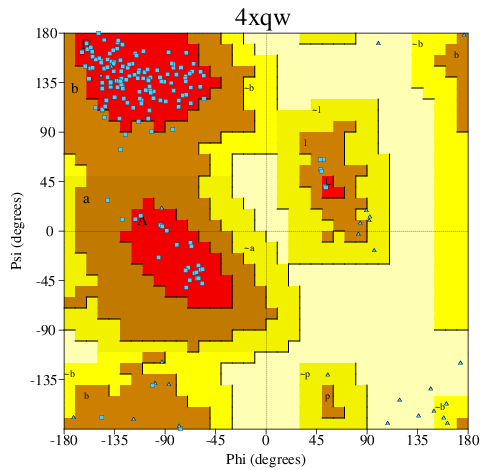
PROCHECK
|
|
|
|
|
|
Headers
|
|
|
|
References
|
|
|
|
|
|

|
|
P36217
(XYN2_HYPJR) -
Endo-1,4-beta-xylanase 2 from Hypocrea jecorina (strain ATCC 56765 / BCRC 32924 / NRRL 11460 / Rut C-30)
|
|
|
|
Seq:
Struc:
|
|
|
|
223 a.a.
189 a.a.*
|
|

|

|
|
|
|
|
|
|
|
|
|
|
|
Key: |
 |
PfamA domain |
|
|
 |
Secondary structure |
|
 |
CATH domain |
|
|
*
PDB and UniProt seqs differ
at 1 residue position (black
cross)
|
|
|
|
|
|
|
|
|
|
|
|
|
Enzyme class:
|
|
E.C.3.2.1.8
- endo-1,4-beta-xylanase.
|
|
|
|
|
|
|
Reaction:
|
|
Endohydrolysis of 1,4-beta-D-xylosidic linkages in xylans.
|
|
|
|
|
|
|
|
|
|
|
|
|
|
|
|
|
|
 |
|
|
|
|
|
|
| |
|
DOI no:
|
Proc Natl Acad Sci U S A
112:12384-12389
(2015)
|
|
PubMed id:
|
|
|
|
|
|
| |
|
Direct determination of protonation states and visualization of hydrogen bonding in a glycoside hydrolase with neutron crystallography.
|
|
Q.Wan,
J.M.Parks,
B.L.Hanson,
S.Z.Fisher,
A.Ostermann,
T.E.Schrader,
D.E.Graham,
L.Coates,
P.Langan,
A.Kovalevsky.
|
|
|
|
|
| |
ABSTRACT
|
|
|
|
| |
|
|
Glycoside hydrolase (GH) enzymes apply acid/base chemistry to catalyze the
decomposition of complex carbohydrates. These ubiquitous enzymes accept protons
from solvent and donate them to substrates at close to neutral pH by modulating
the pKa values of key side chains during catalysis. However, it is not known how
the catalytic acid residue acquires a proton and transfers it efficiently to the
substrate. To better understand GH chemistry, we used macromolecular neutron
crystallography to directly determine protonation and ionization states of the
active site residues of a family 11 GH at multiple pD (pD = pH + 0.4) values.
The general acid glutamate (Glu) cycles between two conformations, upward and
downward, but is protonated only in the downward orientation. We performed
continuum electrostatics calculations to estimate the pKa values of the
catalytic Glu residues in both the apo- and substrate-bound states of the
enzyme. The calculated pKa of the Glu increases substantially when the side
chain moves down. The energy barrier required to rotate the catalytic Glu
residue back to the upward conformation, where it can protonate the glycosidic
oxygen of the substrate, is 4.3 kcal/mol according to free energy simulations.
These findings shed light on the initial stage of the glycoside hydrolysis
reaction in which molecular motion enables the general acid catalyst to obtain a
proton from the bulk solvent and deliver it to the glycosidic oxygen.
|
|
|
|
|
|
|
|
|
|
|
|
|
|
|
|
|
|
 |
 |
 |
|


 Links
Links


