 |
PDBsum entry 4xnq

|
|
|
|
|
|

|

|

|

|
|

|
|

|
|

|
|

|
|

|
|
|
 |

|

|
|
|
|
|
|
|
|
|
|
|
|
|
|
|
|
|
|
|
|
|
|
|
|
|
|
|
|
|
|
|
|
|
|
Viral protein/immune system
|
PDB id
|
|
|
|
4xnq
|
|
|
|
|
|
|
|
|
|
|
|
|
|
|

|

|

|
|
|
|
|
|
|
|
 |
Contents |
 |
|
|
|
|
|
|
|
|
|
|
|

 208 a.a.
|
|
|
|
|
|
|
|
|
|
|

 217 a.a.
|
|
|
|
|
|
|
|
|
|
|

 202 a.a.
|
|
|
|
|
|
|
|
|
|
|
|
|
|
|
PDB id:
|
|
|
|
| Name: |
|
Viral protein/immune system
|
|
|
Title:
|
|
Antibody hemagglutinin complexes
|
|
Structure:
|
|
H5.3 light chain. Chain: a, l. Engineered: yes. H5.3 heavy chain. Chain: b, h. Engineered: yes. Influenza h5 ha head domain vietnam rdt mutations. Chain: d, c. Fragment: unp residues 74-285.
|
|
Source:
|
|
Homo sapiens. Organism_taxid: 9606. Expressed in: homo sapiens. Expression_system_taxid: 9606. Expression_system_cell_line: hybridoma. Influenza a virus. Organism_taxid: 11320. Strain: a/vietnam/1203/2004(h5n1). Expressed in: escherichia coli.
|
|
Resolution:
|
|
|
2.00Å
|
R-factor:
|
0.192
|
R-free:
|
0.225
|
|
|
Authors:
|
|
B.W.Spiller,K.L.Winarski
|
|
Key ref:
|
|
K.L.Winarski
et al.
(2015).
Vaccine-elicited antibody that neutralizes H5N1 influenza and variants binds the receptor site and polymorphic sites.
Proc Natl Acad Sci U S A,
112,
9346-9351.
PubMed id:
DOI:
|
|
|
Date:
|
|
|
15-Jan-15
|
Release date:
|
15-Jul-15
|
|
|
|
|
|
|
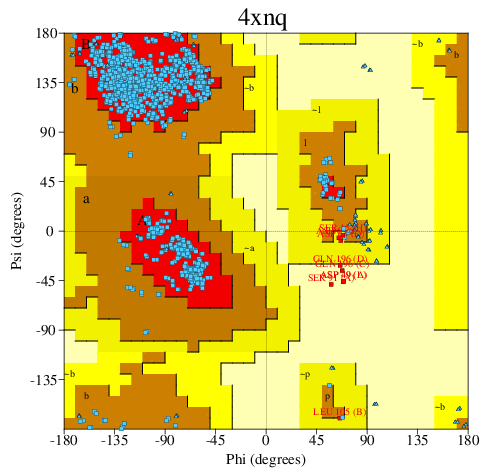
PROCHECK
|
|
|
|
|
|
Headers
|
|
|
|
References
|
|
|
|
|
|

|
|
No UniProt id for this chain
|
|
|
|
|
|
|
|
|
|
|
|
|
|
|
|
|
|
|
|
|
|
|
|
|
 |
|
|
|
|
|
|
| |
|
DOI no:
|
Proc Natl Acad Sci U S A
112:9346-9351
(2015)
|
|
PubMed id:
|
|
|
|
|
|
| |
|
Vaccine-elicited antibody that neutralizes H5N1 influenza and variants binds the receptor site and polymorphic sites.
|
|
K.L.Winarski,
N.J.Thornburg,
Y.Yu,
G.Sapparapu,
J.E.Crowe,
B.W.Spiller.
|
|
|
|
|
| |
ABSTRACT
|
|
|
|
| |
|
|
Antigenic drift of circulating seasonal influenza viruses necessitates an
international vaccine effort to reduce the impact on human health. A critical
feature of the seasonal vaccine is that it stimulates an already primed immune
system to diversify memory B cells to recognize closely related, but
antigenically distinct, influenza glycoproteins (hemagglutinins). Influenza
pandemics arise when hemagglutinins to which no preexisting adaptive immunity
exists acquire the capacity to infect humans. Hemagglutinin 5 is one subtype to
which little preexisting immunity exists and is only a few acquired mutations
away from the ability to transmit efficiently between ferrets, and possibly
humans. Here, we describe the structure and molecular mechanism of
neutralization by H5.3, a vaccine-elicited antibody that neutralizes
hemagglutinin 5 viruses and variants with expanded host range. H5.3 binds in the
receptor-binding site, forming contacts that recapitulate many of the sialic
acid interactions, as well as multiple peripheral interactions, yet is not
sensitive to mutations that alter sialic acid binding. H5.3 is highly specific
for a subset of H5 strains, and this specificity arises from interactions to the
periphery of the receptor-binding site. H5.3 is also extremely potent, despite
retaining germ line-like conformational flexibility.
|
|
|
|
|
|
|
|
|
|
|
|
|
|
|
|
|
|
 |
 |
 |
|
| |


 Links
Links








