 |
PDBsum entry 4x2k
|
|

|
|
PDB id:
|
|
|
|
| Name: |
|
Transferase
|
|
|
Title:
|
|
Selection of fragments for kinase inhibitor design: decoration is key
|
|
Structure:
|
|
Tgf-beta receptor type-1. Chain: a. Synonym: tgfr-1,activin a receptor type ii-like protein kinase of 53kd,activin receptor-like kinase 5,alk5,serine/threonine-protein kinase receptor r4,skr4,tgf-beta type i receptor,transforming growth factor-beta receptor type i,tbetar-i. Engineered: yes
|
|
Source:
|
|
Homo sapiens. Human. Organism_taxid: 9606. Gene: tgfbr1, alk5, skr4. Expressed in: spodoptera frugiperda. Expression_system_taxid: 7108
|
|
Resolution:
|
|
|
1.69Å
|
R-factor:
|
0.167
|
R-free:
|
0.184
|
|
|
Authors:
|
|
P.Czodrowski,G.Hoelzemann,G.Barnickel,H.Greiner,D.Musil
|
|
Key ref:
|
|
P.Czodrowski
et al.
(2015).
Selection of fragments for kinase inhibitor design: decoration is key.
J Med Chem,
58,
457-465.
PubMed id:
DOI:
|
|
|
Date:
|
|
|
26-Nov-14
|
Release date:
|
24-Dec-14
|
|
|
|
|
|
|
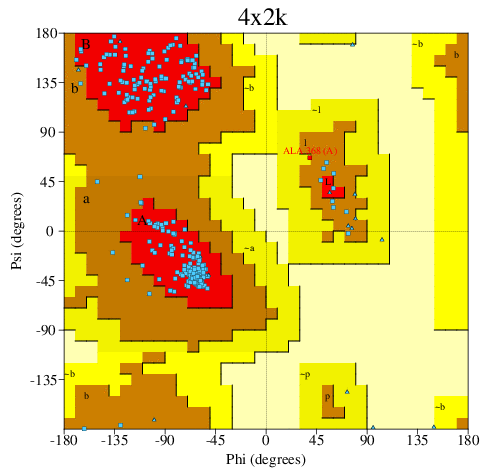
PROCHECK
|
|
|
|
|
|
Headers
|
|
|
|
References
|
|
|
|
|
|

|
|
P36897
(TGFR1_HUMAN) -
TGF-beta receptor type-1 from Homo sapiens
|
|
|
|
Seq:
Struc:
|
|
|
|
503 a.a.
303 a.a.*
|
|

|

|

|
|
|
|
|
|
|
|
|
|
|
Key: |
 |
PfamA domain |
|
|
 |
Secondary structure |
|
 |
CATH domain |
|
|
*
PDB and UniProt seqs differ
at 1 residue position (black
cross)
|
|
|
|
|
|
|
|
|
|
|
|
|
Enzyme class:
|
|
E.C.2.7.11.30
- receptor protein serine/threonine kinase.
|
|
|
|
|
|
|
Reaction:
|
|
|
1.
|
L-seryl-[receptor-protein] + ATP = O-phospho-L-seryl-[receptor- protein] + ADP + H+
|
|
2.
|
L-threonyl-[receptor-protein] + ATP = O-phospho-L-threonyl-[receptor- protein] + ADP + H+
|
|
|
|
|
|
|
L-seryl-[receptor-protein]
|
+
|
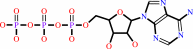 ATP
ATP
|
=
|
O-phospho-L-seryl-[receptor- protein]
|
+
|
 ADP
ADP
|
+
|
H(+)
|
|
|
|
|
|
|
L-threonyl-[receptor-protein]
|
+
|
ATP
|
=
|
O-phospho-L-threonyl-[receptor- protein]
|
+
|
ADP
|
+
|
H(+)
|
|
|
|
|
|
|
|
|
|
|
|
|
Molecule diagrams generated from .mol files obtained from the
KEGG ftp site
|
|
|
|
|
|
|
|
|
|
|
|
|
|
 |
|
|
|
|
|
|
| |
|
|
| |
|
DOI no:
|
J Med Chem
58:457-465
(2015)
|
|
PubMed id:
|
|
|
|
|
|
| |
|
Selection of fragments for kinase inhibitor design: decoration is key.
|
|
P.Czodrowski,
G.Hölzemann,
G.Barnickel,
H.Greiner,
D.Musil.
|
|
|
|
|
| |
ABSTRACT
|
|
|
|
| |
|
|
In fragment-based screening, the choice of the best suited fragment hit among
the detected hits is crucial for success. In our study, a kinase lead compound
was fragmented, the hinge-binding motif extracted as a core fragment, and a
minilibrary of five similar compounds with fragment-like properties was selected
from our proprietary compound database. The structures of five fragments in
complex with transforming growth factor β receptor type 1 kinase domain were
determined by X-ray crystallography. Three different binding modes of the
fragments are observed that depend on the position and the type of the
substitution at the core fragment. The influence of different substituents on
the preferred fragment pose was analyzed by various computational approaches. We
postulate that the replacement of water molecules leads to the different binding
modes.
|
|
|
|
|
|
|
|
|
|
|
|
|
|
|
|
|
|
 |
 |
 |
|


 Links
Links


