 |
PDBsum entry 4udb

|
|
|
|
|
|

|

|

|

|
|

|
|

|
|

|
|

|
|

|
|
|
 |

|

|
|
|
|
|
|
|
|
|
|
|
|
|
|
|
|
|
|
|
|
|
|
|
|
|
|
|
|
|
|
|
|
|
|
Signaling protein
|
PDB id
|
|
|
|
4udb
|
|
|
|
|
|
|
|
|
|
|
|
|
|
|

|

|

|
|
|
|
|
|
|
PDB id:
|
|
|
|
| Name: |
|
Signaling protein
|
|
|
Title:
|
|
Mr in complex with desisobutyrylciclesonide
|
|
Structure:
|
|
Mineralocorticoid receptor. Chain: a. Fragment: ligand binding domain, residues 735-984. Synonym: mr, nuclear receptor subfamily 3 group c member 2. Engineered: yes. Mutation: yes. Nuclear receptor coactivator 1. Chain: b. Fragment: residues 1427-1441.
|
|
Source:
|
|
Homo sapiens. Human. Organism_taxid: 9606. Expressed in: escherichia coli. Expression_system_taxid: 511693.
|
|
Resolution:
|
|
|
2.36Å
|
R-factor:
|
0.184
|
R-free:
|
0.218
|
|
|
Authors:
|
|
K.Edman,A.Hogner,A.Hussein,A.Aagaard,S.Backstrom,C.Bodin,L.Wissler, T.Jellesmarkjensen,A.Cavallin,E.Nilsson,M.Lepisto,V.Guallar
|
|
Key ref:
|
|
K.Edman
et al.
(2015).
Ligand Binding Mechanism in Steroid Receptors: From Conserved Plasticity to Differential Evolutionary Constraints.
Structure,
23,
2280-2290.
PubMed id:
DOI:
|
|
|
Date:
|
|
|
09-Dec-14
|
Release date:
|
25-Nov-15
|
|
|
|
|
|
|
PROCHECK
|

|
|
|
|
|
Headers
|
|
|
|
References
|
|
|
|
|
|
|
|
|
|
|
|
Enzyme class:
|
|
Chain B:
E.C.2.3.1.48
- histone acetyltransferase.
|
|
|
|
|
|
|
Reaction:
|
|
L-lysyl-[protein] + acetyl-CoA = N6-acetyl-L-lysyl-[protein] + CoA + H+
|
|
|
|
|
|
L-lysyl-[protein]
|
+
|
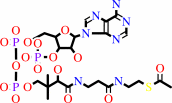 acetyl-CoA
|
=
|
N(6)-acetyl-L-lysyl-[protein]
|
+
|
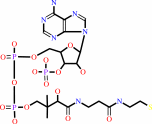 CoA
CoA
|
+
|
H(+)
|
|
|
|
|
|
|
|
|
|
|
|
|
Molecule diagrams generated from .mol files obtained from the
KEGG ftp site
|
|
|
|
|
|
|
|
|
|
|
|
|
|
 |
|
|
|
|
|
|
| |
|
|
| |
|
DOI no:
|
Structure
23:2280-2290
(2015)
|
|
PubMed id:
|
|
|
|
|
|
| |
|
Ligand Binding Mechanism in Steroid Receptors: From Conserved Plasticity to Differential Evolutionary Constraints.
|
|
K.Edman,
A.Hosseini,
M.K.Bjursell,
A.Aagaard,
L.Wissler,
A.Gunnarsson,
T.Kaminski,
C.Köhler,
S.Bäckström,
T.J.Jensen,
A.Cavallin,
U.Karlsson,
E.Nilsson,
D.Lecina,
R.Takahashi,
C.Grebner,
S.Geschwindner,
M.Lepistö,
A.C.Hogner,
V.Guallar.
|
|
|
|
|
| |
ABSTRACT
|
|
|
|
| |
|
|
Steroid receptor drugs have been available for more than half a century, but
details of the ligand binding mechanism have remained elusive. We solved X-ray
structures of the glucocorticoid and mineralocorticoid receptors to identify a
conserved plasticity at the helix 6-7 region that extends the ligand binding
pocket toward the receptor surface. Since none of the endogenous ligands exploit
this region, we hypothesized that it constitutes an integral part of the binding
event. Extensive all-atom unbiased ligand exit and entrance simulations
corroborate a ligand binding pathway that gives the observed structural
plasticity a key functional role. Kinetic measurements reveal that the receptor
residence time correlates with structural rearrangements observed in both
structures and simulations. Ultimately, our findings reveal why nature has
conserved the capacity to open up this region, and highlight how differences in
the details of the ligand entry process result in differential evolutionary
constraints across the steroid receptors.
|
|
|
|
|
|
|
|
|
|
|
|
|
|
|
|
|
|
 |
 |
 |
|
|


 Links
Links


