 |
PDBsum entry 4plz

|
|
|
|
|
|

|

|

|

|
|

|
|

|
|

|
|
|
 |

|

|
|
|
|
|
|
|
|
|
|
|
|
|
|
|
|
|
|
|
|
|
|
|
|
|
|
|
|
|
|
|
|
Oxidoreductase
|
PDB id
|
|
|
|
4plz
|
|
|
|
|
|
|
|
|
|
|
|
|
|
|

|

|

|
|
|
|
|
|
|
|
|
Enzyme class:
|
|
E.C.1.1.1.27
- L-lactate dehydrogenase.
|
|
|
|
|
|
|
Reaction:
|
|
(S)-lactate + NAD+ = pyruvate + NADH + H+
|
|
|
|
|
|
(S)-lactate
Bound ligand (Het Group name = )
matches with 71.43% similarity
|
+
|
NAD(+)
Bound ligand (Het Group name = )
corresponds exactly
|
=
|
 pyruvate
|
+
|
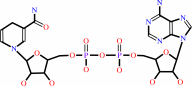 NADH
NADH
|
+
|
H(+)
|
|
|
|
|
|
|
|
|
|
|
|
|
Molecule diagrams generated from .mol files obtained from the
KEGG ftp site
|
|
|
|
|
|
|
|
|
|
|
|
|
|
 |
|
|
|
|
|
|
| |
|
|
| |
|
DOI no:
|
Elife
3:e02304
(2014)
|
|
PubMed id:
|
|
|
|
|
|
| |
|
An atomic-resolution view of neofunctionalization in the evolution of apicomplexan lactate dehydrogenases.
|
|
J.I.Boucher,
J.R.Jacobowitz,
B.C.Beckett,
S.Classen,
D.L.Theobald.
|
|
|
|
|
| |
ABSTRACT
|
|
|
|
| |
|
|
Malate and lactate dehydrogenases (MDH and LDH) are homologous, core metabolic
enzymes that share a fold and catalytic mechanism yet possess strict specificity
for their substrates. In the Apicomplexa, convergent evolution of an unusual LDH
from MDH produced a difference in specificity exceeding 12 orders of magnitude.
The mechanisms responsible for this extraordinary functional shift are currently
unknown. Using ancestral protein resurrection, we find that specificity evolved
in apicomplexan LDHs by classic neofunctionalization characterized by long-range
epistasis, a promiscuous intermediate, and few gain-of-function mutations of
large effect. In canonical MDHs and LDHs, a single residue in the active-site
loop governs substrate specificity: Arg102 in MDHs and Gln102 in LDHs. During
the evolution of the apicomplexan LDH, however, specificity switched via an
insertion that shifted the position and identity of this 'specificity residue'
to Trp107f. Residues far from the active site also determine specificity, as
shown by the crystal structures of three ancestral proteins bracketing the key
duplication event. This work provides an unprecedented atomic-resolution view of
evolutionary trajectories creating a nascent enzymatic function.
|
|
|
|
|
|
|
|
|
|
|
|
|
|
|
|
|
|
 |
 |
 |
|


 Links
Links


