|
PDBsum entry 4o2f

|
|
|
|
|
|

|

|

|

|
|

|
|

|
|

|
|

|
|

|
|

|
|
|
 |

|

|
|
|
|
|
|
|
|
|
|
|
|
|
|
|
|
|
|
|
|
|
|
|
|
|
|
|
|
|
|
|
|
|
|
|
Immune system
|
PDB id
|
|
|
|
4o2f
|
|
|
|
|
|
|
|
|
|
|
|
|
|
|

|

|

|
|
|
|
|
|
|
PDB id:
|
|
|
|
| Name: |
|
Immune system
|
|
|
Title:
|
|
A peptide complexed with hla-b 3901
|
|
Structure:
|
|
Hla class i histocompatibility antigen, b-39 alpha chain. Chain: a, d. Fragment: unp residues 25-298. Synonym: mhc class i antigen b 39. Engineered: yes. Beta-2-microglobulin. Chain: b, e. Synonym: beta-2-microglobulin form pi 5.3. Engineered: yes.
|
|
Source:
|
|
Homo sapiens. Human. Organism_taxid: 9606. Gene: hla-b, hlab. Expressed in: escherichia coli. Expression_system_taxid: 562. Gene: b2m, cdabp0092, hdcma22p. Synthetic: yes. Organism_taxid: 9606
|
|
Resolution:
|
|
|
1.90Å
|
R-factor:
|
0.187
|
R-free:
|
0.213
|
|
|
Authors:
|
|
M.Sun,J.Liu,J.Qi,B.Tefsen,Y.Shi,J.Yan,G.F.Gao
|
|
Key ref:
|
|
M.Sun
et al.
(2014).
Nα-terminal acetylation for T cell recognition: molecular basis of MHC class I-restricted nα-acetylpeptide presentation.
J Immunol,
192,
5509-5519.
PubMed id:
DOI:
|
|
|
Date:
|
|
|
17-Dec-13
|
Release date:
|
23-Jul-14
|
|
|
|
|
|
|
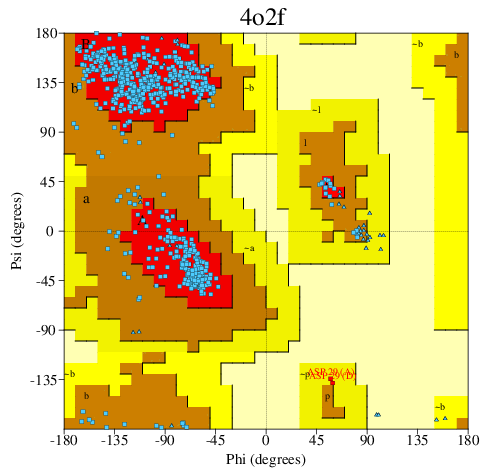
PROCHECK
|
|
|
|
|
|
Headers
|
|
|
|
References
|
|
|
|
|
|
|
|
|
|
|
|
|
|
|
|
 |
|
|
|
|
|
|
| |
|
DOI no:
|
J Immunol
192:5509-5519
(2014)
|
|
PubMed id:
|
|
|
|
|
|
| |
|
Nα-terminal acetylation for T cell recognition: molecular basis of MHC class I-restricted nα-acetylpeptide presentation.
|
|
M.Sun,
J.Liu,
J.Qi,
B.Tefsen,
Y.Shi,
J.Yan,
G.F.Gao.
|
|
|
|
|
| |
ABSTRACT
|
|
|
|
| |
|
|
As one of the most common posttranslational modifications (PTMs) of eukaryotic
proteins, N(α)-terminal acetylation (Nt-acetylation) generates a class of
N(α)-acetylpeptides that are known to be presented by MHC class I at the cell
surface. Although such PTM plays a pivotal role in adjusting proteolysis, the
molecular basis for the presentation and T cell recognition of
N(α)-acetylpeptides remains largely unknown. In this study, we determined a
high-resolution crystallographic structure of HLA (HLA)-B*3901 complexed with an
N(α)-acetylpeptide derived from natural cellular processing, also in comparison
with the unmodified-peptide complex. Unlike the α-amino-free P1 residues of
unmodified peptide, of which the α-amino group inserts into pocket A of the
Ag-binding groove, the N(α)-linked acetyl of the acetylated P1-Ser protrudes
out of the groove for T cell recognition. Moreover, the Nt-acetylation not only
alters the conformation of the peptide but also switches the residues in the
α1-helix of HLA-B*3901, which may impact the T cell engagement. The
thermostability measurements of complexes between N(α)-acetylpeptides and a
series of MHC class I molecules derived from different species reveal reduced
stability. Our findings provide the insight into the mode of
N(α)-acetylpeptide-specific presentation by classical MHC class I molecules and
shed light on the potential of acetylepitope-based immune intervene and vaccine
development.
|
|
|
|
|
|
|
|
|
|
|
|
|
|
|
|
|
|
 |
 |
 |
|
|


 Links
Links