 |
PDBsum entry 4m9h

|
|
|
|
|
|

|

|

|

|
|

|
|

|
|

|
|

|
|

|
|

|
|

|
|
|
 |

|

|
|
|
|
|
|
|
|
|
|
|
|
|
|
|
|
|
|
|
|
|
|
|
|
|
|
|
|
|
|
|
|
|
|
|
|
Transferase/DNA
|
PDB id
|
|
|
|
4m9h
|
|
|
|
|
|
|
|
|
|
|
|
|
|
|

|

|

|
|
|
|
|
|
|
|
|
Enzyme class 1:
|
|
E.C.2.7.7.7
- DNA-directed Dna polymerase.
|
|
|
|
|
|
|
Reaction:
|
|
DNA(n) + a 2'-deoxyribonucleoside 5'-triphosphate = DNA(n+1) + diphosphate
|
|
|
|
|
|
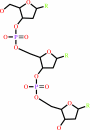 DNA(n)
|
+
|
2'-deoxyribonucleoside 5'-triphosphate
|
=
|
DNA(n+1)
Bound ligand (Het Group name = )
matches with 69.23% similarity
|
+
|
 diphosphate
|
|
|
|
|
|
|
|
|
|
Enzyme class 2:
|
|
E.C.4.2.99.-
- ?????
|
|
|
|
|
|
|
Enzyme class 3:
|
|
E.C.4.2.99.18
- DNA-(apurinic or apyrimidinic site) lyase.
|
|
|
|
|
|
|
Reaction:
|
|
2'-deoxyribonucleotide-(2'-deoxyribose 5'-phosphate)- 2'-deoxyribonucleotide-DNA = a 3'-end 2'-deoxyribonucleotide-(2,3- dehydro-2,3-deoxyribose 5'-phosphate)-DNA + a 5'-end 5'-phospho- 2'-deoxyribonucleoside-DNA + H+
|
|
|
|
|
|
|
|
|
Note, where more than one E.C. class is given (as above), each may
correspond to a different protein domain or, in the case of polyprotein
precursors, to a different mature protein.
|
|
|
|
Molecule diagrams generated from .mol files obtained from the
KEGG ftp site
|
|
|
|
|
|
|
|
|
|
|
|
|
|
 |
|
|
|
|
|
|
| |
|
|
| |
|
DOI no:
|
J Biol Chem
288:34850-34860
(2013)
|
|
PubMed id:
|
|
|
|
|
|
| |
|
The E295K cancer variant of human polymerase β favors the mismatch conformational pathway during nucleotide selection.
|
|
B.E.Eckenroth,
J.B.Towle-Weicksel,
J.B.Sweasy,
S.Doublié.
|
|
|
|
|
| |
ABSTRACT
|
|
|
|
| |
|
|
DNA polymerase β (pol β) is responsible for gap filling synthesis during
repair of damaged DNA as part of the base excision repair pathway. Human pol β
mutations were recently identified in a high percentage (∼30%) of tumors.
Characterization of specific cancer variants is particularly useful to further
the understanding of the general mechanism of pol β while providing context to
disease contribution. We showed that expression of the carcinoma variant E295K
induces cellular transformation. The poor polymerase activity exhibited by the
variant was hypothesized to be caused by the destabilization of proper active
site assembly by the glutamate to lysine mutation. Here, we show that this
variant exhibits an unusual preference for binding dCTP opposite a templating
adenine over the cognate dTTP. Biochemical studies indicate that the noncognate
competes with the cognate nucleotide for binding to the polymerase active site
with the noncognate incorporation a function of higher affinity and not
increased activity. In the crystal structure of the variant bound to dA:dCTP,
the fingers domain closes around the mismatched base pair. Nucleotide
incorporation is hindered because key residues in the polymerase active site are
not properly positioned for nucleotidyl transfer. In contrast to the noncognate
dCTP, neither the cognate dTTP nor its nonhydrolyzable analog induced fingers
closure, as isomorphous difference Fourier maps show that the cognate
nucleotides are bound to the open state of the polymerase. Comparison with
published structures provides insight into the structural rearrangements within
pol β that occur during the process of nucleotide discrimination.
|
|
|
|
|
|
|
|
|
|
|
|
|
|
|
|
|
|
 |
 |
 |
|


 Links
Links


