 |
PDBsum entry 4l94

|
|
|
|
|
|

|

|

|

|
|

|
|

|
|

|
|
|
 |

|

|
|
|
|
|
|
|
|
|
|
|
|
|
|
|
|
|
|
|
|
|
|
|
|
|
|
|
|
|
|
|
|
Chaperone/chaperone inhibitor
|
PDB id
|
|
|
|
4l94
|
|
|
|
|
|
|
|
|
|
|
|
|
|
|

|

|

|
|
|
|
|
|
|
|
|
Enzyme class:
|
|
E.C.3.6.4.10
- non-chaperonin molecular chaperone ATPase.
|
|
|
|
|
|
|
Reaction:
|
|
ATP + H2O = ADP + phosphate + H+
|
|
|
|
|
|
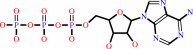 ATP
ATP
|
+
|
H2O
|
=
|
 ADP
ADP
|
+
|
 phosphate
|
+
|
H(+)
|
|
|
|
|
|
|
|
|
|
|
|
|
Molecule diagrams generated from .mol files obtained from the
KEGG ftp site
|
|
|
|
|
|
|
|
|
|
|
|
|
|
 |
|
|
|
|
|
|
| |
|
|
| |
|
DOI no:
|
Bioorg Med Chem Lett
24:2525-2529
(2014)
|
|
PubMed id:
|
|
|
|
|
|
| |
|
Identification of a new series of potent diphenol HSP90 inhibitors by fragment merging and structure-based optimization.
|
|
J.Ren,
J.Li,
Y.Wang,
W.Chen,
A.Shen,
H.Liu,
D.Chen,
D.Cao,
Y.Li,
N.Zhang,
Y.Xu,
M.Geng,
J.He,
B.Xiong,
J.Shen.
|
|
|
|
|
| |
ABSTRACT
|
|
|
|
| |
|
|
Heat shock protein 90 (HSP90) is a molecular chaperone to fold and maintain the
proper conformation of many signaling proteins, especially some oncogenic
proteins and mutated unstable proteins. Inhibition of HSP90 was recognized as an
effective approach to simultaneously suppress several aberrant signaling
pathways, and therefore it was considered as a novel target for cancer therapy.
Here, by integrating several techniques including the fragment-based drug
discovery method, fragment merging, computer aided inhibitor optimization, and
structure-based drug design, we were able to identify a series of HSP90
inhibitors. Among them, inhibitors 13, 32, 36 and 40 can inhibit HSP90 with IC50
about 20-40 nM, which is at least 200-fold more potent than initial fragments in
the protein binding assay. These new HSP90 inhibitors not only explore
interactions with an under-studied subpocket, also offer new chemotypes for the
development of novel HSP90 inhibitors as anticancer drugs.
|
|
|
|
|
|
|
|
|
|
|
|
|
|
|
|
|
|
 |
 |
 |
|


 Links
Links


