 |
PDBsum entry 4l2x

|
|
|
|
|
|

|

|

|

|
|

|
|

|
|

|
|

|
|

|
|

|
|
|
 |

|

|
|
|
|
|
|
|
|
|
|
|
|
|
|
|
|
|
|
|
|
|
|
|
|
|
|
|
|
|
|
|
|
|
|
|
Transferase/transferase inhibitor
|
PDB id
|
|
|
|
4l2x
|
|
|
|
|
|
|
|
|
|
|
|
|
|
|

|

|

|
|
|
|
|
|
|
|
|
Enzyme class 1:
|
|
E.C.2.5.1.1
- dimethylallyltranstransferase.
|
|
|
|
|
|
|
Pathway:
|
|
Terpenoid biosynthesis
|
|
|
|
|
|
Reaction:
|
|
isopentenyl diphosphate + dimethylallyl diphosphate = (2E)- geranyl diphosphate + diphosphate
|
|
|
|
|
|
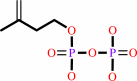 isopentenyl diphosphate
|
+
|
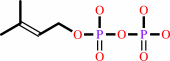 dimethylallyl diphosphate
|
=
|
(2E)- geranyl diphosphate
|
+
|
diphosphate
Bound ligand (Het Group name = )
corresponds exactly
|
|
|
|
|
|
|
|
|
|
Enzyme class 2:
|
|
E.C.2.5.1.10
- (2E,6E)-farnesyl diphosphate synthase.
|
|
|
|
|
|
|
Pathway:
|
|
|
|
|
|
|
|
Reaction:
|
|
isopentenyl diphosphate + (2E)-geranyl diphosphate = (2E,6E)-farnesyl diphosphate + diphosphate
|
|
|
|
|
|
isopentenyl diphosphate
|
+
|
(2E)-geranyl diphosphate
|
=
|
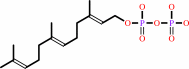 (2E,6E)-farnesyl diphosphate
|
+
|
diphosphate
Bound ligand (Het Group name = )
corresponds exactly
|
|
|
|
|
|
|
|
|
|
|
|
|
Note, where more than one E.C. class is given (as above), each may
correspond to a different protein domain or, in the case of polyprotein
precursors, to a different mature protein.
|
|
|
|
Molecule diagrams generated from .mol files obtained from the
KEGG ftp site
|
|
|
|
|
|
|
|
|
|
|
|
|
|
 |
|
|
|
|
|
|
| |
|
|
| |
|
DOI no:
|
J Med Chem
56:7939-7950
(2013)
|
|
PubMed id:
|
|
|
|
|
|
| |
|
Thienopyrimidine bisphosphonate (ThPBP) inhibitors of the human farnesyl pyrophosphate synthase: optimization and characterization of the mode of inhibition.
|
|
C.Y.Leung,
J.Park,
J.W.De Schutter,
M.Sebag,
A.M.Berghuis,
Y.S.Tsantrizos.
|
|
|
|
|
| |
ABSTRACT
|
|
|
|
| |
|
|
Human farnesyl pyrophosphate synthase (hFPPS) controls the post-translational
prenylation of small GTPase proteins that are essential for cell signaling, cell
proliferation, and osteoclast-mediated bone resorption. Inhibition of hFPPS is a
clinically validated mechanism for the treatment of lytic bone diseases,
including osteoporosis and cancer related bone metastases. A new series of
thienopyrimidine-based bisphosphonates (ThP-BPs) were identified that inhibit
hFPPS with low nanomolar potency. Crystallographic evidence revealed binding of
ThP-BP inhibitors in the allylic subpocket of hFPPS. Simultaneous binding of
inorganic pyrophosphate in the IPP subpocket leads to conformational closing of
the active site cavity. The ThP-BP analogues are significantly less hydrophilic
yet exhibit higher affinity for the bone mineral hydroxyapatite than the current
N-BP drug risedronic acid. The antiproliferation properties of a potent ThB-BP
analogue was assessed in a multiple myeloma cell line and found to be equipotent
to the best current N-BP drugs. Consequently, these compounds represent a new
structural class of hFPPS inhibitors and a novel scaffold for the development of
human therapeutics.
|
|
|
|
|
|
|
|
|
|
|
|
|
|
|
|
|
|
 |
 |
 |
|


 Links
Links


