 |
PDBsum entry 4jpy

|
|
|
|
|
|

|

|

|

|
|

|
|

|
|

|
|

|
|
|
 |

|

|
|
|
|
|
|
|
|
|
|
|
|
|
|
|
|
|
|
|
|
|
|
|
|
|
|
|
|
|
|
|
|
|
Oxidoreductase
|
PDB id
|
|
|
|
4jpy
|
|
|
|
|
|
|
|
|
|
|
|
|
|
|

|

|

|
|
|
|
|
|
|
|
|
Enzyme class:
|
|
E.C.1.14.16.1
- phenylalanine 4-monooxygenase.
|
|
|
|
|
|
|
Pathway:
|
|
Phenylalanine and Tyrosine Biosynthesis
|
|
|
|
|
|
Reaction:
|
|
(6R)-L-erythro-5,6,7,8-tetrahydrobiopterin + L-phenylalanine + O2 = (4aS,6R)-4a-hydroxy-L-erythro-5,6,7,8-tetrahydrobiopterin + L-tyrosine
|
|
|
|
|
|
(6R)-L-erythro-5,6,7,8-tetrahydrobiopterin
|
+
|
L-phenylalanine
Bound ligand (Het Group name = )
corresponds exactly
|
+
|
 O2
O2
|
=
|
(4aS,6R)-4a-hydroxy-L-erythro-5,6,7,8-tetrahydrobiopterin
|
+
|
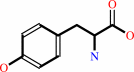 L-tyrosine
|
|
|
|
|
|
|
|
|
|
Cofactor:
|
|
Fe cation
|
|
|
|
|
|
|
|
|
Molecule diagrams generated from .mol files obtained from the
KEGG ftp site
|
|
|
|
|
|
|
|
|
|
|
|
|
|
 |
|
|
|
|
|
|
| |
|
|
| |
|
DOI no:
|
Eur Biophys J
42:691-708
(2013)
|
|
PubMed id:
|
|
|
|
|
|
| |
|
An additional substrate binding site in a bacterial phenylalanine hydroxylase.
|
|
J.A.Ronau,
L.N.Paul,
J.E.Fuchs,
I.R.Corn,
K.T.Wagner,
K.R.Liedl,
M.M.Abu-Omar,
C.Das.
|
|
|
|
|
| |
ABSTRACT
|
|
|
|
| |
|
|
Phenylalanine hydroxylase (PAH) is a non-heme iron enzyme that catalyzes
oxidation of phenylalanine to tyrosine, a reaction that must be kept under tight
regulatory control. Mammalian PAH has a regulatory domain in which binding of
the substrate leads to allosteric activation of the enzyme. However, the
existence of PAH regulation in evolutionarily distant organisms, for example
some bacteria in which it occurs, has so far been underappreciated. In an
attempt to crystallographically characterize substrate binding by PAH from
Chromobacterium violaceum, a single-domain monomeric enzyme, electron density
for phenylalanine was observed at a distal site 15.7 Å from the active site.
Isothermal titration calorimetry (ITC) experiments revealed a dissociation
constant of 24 ± 1.1 μM for phenylalanine. Under the same conditions, ITC
revealed no detectable binding for alanine, tyrosine, or isoleucine, indicating
the distal site may be selective for phenylalanine. Point mutations of amino
acid residues in the distal site that contact phenylalanine (F258A, Y155A,
T254A) led to impaired binding, consistent with the presence of distal site
binding in solution. Although kinetic analysis revealed that the distal site
mutants suffer discernible loss of their catalytic activity, X-ray
crystallographic analysis of Y155A and F258A, the two mutants with the most
noticeable decrease in activity, revealed no discernible change in the structure
of their active sites, suggesting that the effect of distal binding may result
from protein dynamics in solution.
|
|
|
|
|
|
|
|
|
|
|
|
|
|
|
|
|
|
 |
 |
 |
|


 Links
Links


