 |
PDBsum entry 4jbv

|
|
|
|
|
|

|

|

|

|
|

|
|

|
|

|
|

|
|

|
|
|
 |

|

|
|
|
|
|
|
|
|
|
|
|
|
|
|
|
|
|
|
|
|
|
|
|
|
|
|
|
|
|
|
|
|
|
|
Transferase/transferase inhibitor
|
PDB id
|
|
|
|
4jbv
|
|
|
|
|
|
|
|
|
|
|
|
|
|
|

|

|

|
|
|
|
|
|
|
|
|
Enzyme class:
|
|
E.C.2.7.11.17
- calcium/calmodulin-dependent protein kinase.
|
|
|
|
|
|
|
Reaction:
|
|
|
1.
|
L-seryl-[protein] + ATP = O-phospho-L-seryl-[protein] + ADP + H+
|
|
2.
|
L-threonyl-[protein] + ATP = O-phospho-L-threonyl-[protein] + ADP + H+
|
|
|
|
|
|
|
L-seryl-[protein]
|
+
|
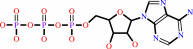 ATP
ATP
|
=
|
O-phospho-L-seryl-[protein]
|
+
|
 ADP
ADP
|
+
|
H(+)
|
|
|
|
|
|
|
L-threonyl-[protein]
|
+
|
ATP
|
=
|
O-phospho-L-threonyl-[protein]
|
+
|
ADP
|
+
|
H(+)
|
|
|
|
|
|
|
|
|
|
Cofactor:
|
|
Ca(2+)
|
|
|
|
|
|
|
|
|
Molecule diagrams generated from .mol files obtained from the
KEGG ftp site
|
|
|
|
|
|
|
|
|
|
|
|
|
|
 |
|
|
|
|
|
|
| |
|
|
| |
|
DOI no:
|
Eur J Med Chem
74:562-573
(2014)
|
|
PubMed id:
|
|
|
|
|
|
| |
|
Development of potent and selective Plasmodium falciparum calcium-dependent protein kinase 4 (PfCDPK4) inhibitors that block the transmission of malaria to mosquitoes.
|
|
R.S.Vidadala,
K.K.Ojo,
S.M.Johnson,
Z.Zhang,
S.E.Leonard,
A.Mitra,
R.Choi,
M.C.Reid,
K.R.Keyloun,
A.M.Fox,
M.Kennedy,
T.Silver-Brace,
J.C.Hume,
S.Kappe,
C.L.Verlinde,
E.Fan,
E.A.Merritt,
W.C.Van Voorhis,
D.J.Maly.
|
|
|
|
|
| |
ABSTRACT
|
|
|
|
| |
|
|
Malaria remains a major health concern for a large percentage of the world's
population. While great strides have been made in reducing mortality due to
malaria, new strategies and therapies are still needed. Therapies that are
capable of blocking the transmission of Plasmodium parasites are particularly
attractive, but only primaquine accomplishes this, and toxicity issues hamper
its widespread use. In this study, we describe a series of pyrazolopyrimidine-
and imidazopyrazine-based compounds that are potent inhibitors of PfCDPK4, which
is a calcium-activated Plasmodium protein kinase that is essential for
exflagellation of male gametocytes. Thus, PfCDPK4 is essential for the sexual
development of Plasmodium parasites and their ability to infect mosquitoes. We
demonstrate that two structural features in the ATP-binding site of PfCDPK4 can
be exploited in order to obtain potent and selective inhibitors of this enzyme.
Furthermore, we demonstrate that pyrazolopyrimidine-based inhibitors that are
potent inhibitors of the in vitro activity of PfCDPK4 are also able to block
Plasmodium falciparum exflagellation with no observable toxicity to human cells.
This medicinal chemistry effort serves as a valuable starting point in the
development of safe, transmission-blocking agents for the control of malaria.
|
|
|
|
|
|
|
|
|
|
|
|
|
|
|
|
|
|
 |
 |
 |
|


 Links
Links


