 |
PDBsum entry 4glw

|
|
|
|
|
|

|

|

|

|
|

|
|

|
|

|
|

|
|

|
|
|
 |

|

|
|
|
|
|
|
|
|
|
|
|
|
|
|
|
|
|
|
|
|
|
|
|
|
|
|
|
|
|
|
|
|
|
|
Ligase/ligase inhibitor
|
PDB id
|
|
|
|
4glw
|
|
|
|
|
|
|
|
|
|
|
|
|
|
|

|

|

|
|
|
|
|
|
|
|
|
Enzyme class:
|
|
E.C.6.5.1.2
- Dna ligase (NAD(+)).
|
|
|
|
|
|
|
Reaction:
|
|
NAD+ + (deoxyribonucleotide)n-3'-hydroxyl + 5'-phospho- (deoxyribonucleotide)m = (deoxyribonucleotide)n+m + AMP + beta- nicotinamide D-nucleotide
|
|
|
|
|
|
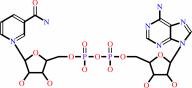 NAD(+)
|
+
|
(deoxyribonucleotide)n-3'-hydroxyl
|
+
|
5'-phospho- (deoxyribonucleotide)m
|
=
|
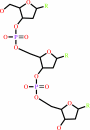 (deoxyribonucleotide)n+m
|
+
|
AMP
Bound ligand (Het Group name = )
matches with 73.08% similarity
|
+
|
beta- nicotinamide D-nucleotide
|
|
|
|
|
|
|
|
|
|
|
|
|
Molecule diagrams generated from .mol files obtained from the
KEGG ftp site
|
|
|
|
|
|
|
|
|
|
|
|
|
|
 |
|
|
|
|
|
|
| |
|
|
| |
|
|
Bioorg Med Chem Lett
22:6705-6711
(2012)
|
|
PubMed id:
|
|
|
|
|
|
| |
|
Structure-guided design, synthesis and biological evaluation of novel DNA ligase inhibitors with in vitro and in vivo anti-staphylococcal activity.
|
|
J.P.Surivet,
R.Lange,
C.Hubschwerlen,
W.Keck,
J.L.Specklin,
D.Ritz,
D.Bur,
H.Locher,
P.Seiler,
D.S.Strasser,
L.Prade,
C.Kohl,
C.Schmitt,
G.Chapoux,
E.Ilhan,
N.Ekambaram,
A.Athanasiou,
A.Knezevic,
D.Sabato,
A.Chambovey,
M.Gaertner,
M.Enderlin,
M.Boehme,
V.Sippel,
P.Wyss.
|
|
|
|
|
| |
ABSTRACT
|
|
|
|
| |
|
|
A series of 2-amino-[1,8]-naphthyridine-3-carboxamides (ANCs) with potent
inhibition of bacterial NAD(+)-dependent DNA ligases (LigAs) evolved from a
2,4-diaminopteridine derivative discovered by HTS. The design was guided by
several highly resolved X-ray structures of our inhibitors in complex with
either Streptococcus pneumoniae or Escherichia coli LigA. The
structure-activity-relationship based on the ANC scaffold is discussed. The
in-depth characterization of
2-amino-6-bromo-7-(trifluoromethyl)-[1,8]-naphthyridine-3-carboxamide, which
displayed promising in vitro (MIC Staphylococcus aureus 1mg/L) and in vivo
anti-staphylococcal activity, is presented.
|
|
|
|
|
|
|
|
|
|
|
|
|
|
|
|
|
|
 |
 |
 |
|


 Links
Links


